
craft · 11min read · 2026-02-25
Japanese Bonsai Guide: Philosophy, Styles, Care, and Where to Begin
Learn the art of bonsai from Japan's centuries-old tradition. Styles, species, care routines, where to see bonsai in Japan, and how to start your first tree.
Key Takeaways
- Bonsai is a living art form with some trees documented over 500 years old
- The practice originated in China as penjing and was refined in Japan
- Omiya Bonsai Village was established after the 1923 Great Kanto Earthquake
- Formal upright, informal upright, and cascade are the main recognized styles
- Daily care involves checking soil moisture, sunlight, and seasonal pruning
What Is Bonsai? More Than a Small Tree
Bonsai is not a species of tree. It is a relationship between a human being, a living plant, and time itself. The word combines two Japanese characters: "bon" (tray or pot) and "sai" (planting). But this etymological simplicity masks an art form that has occupied Japanese gardeners, monks, samurai, and emperors for over 700 years.
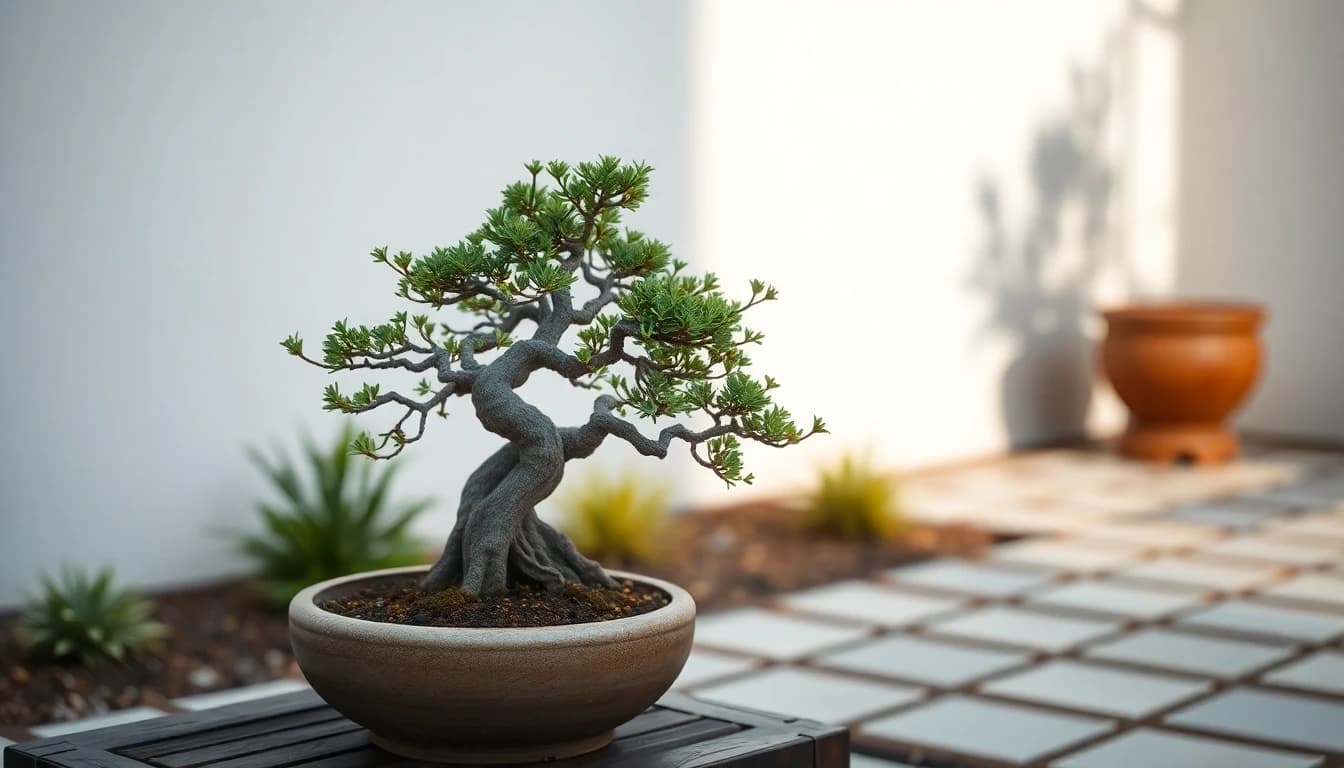
A bonsai is a full-sized tree -- genetically identical to its forest counterpart -- trained through pruning, wiring, and careful cultivation to express the essence of a mature tree within the confines of a shallow container. A 40-centimeter Japanese black pine bonsai may be 150 years old, its trunk scarred by decades of deliberate shaping, its canopy a miniature recreation of a windswept coastal pine.
This is the distinction that separates bonsai from houseplants. A houseplant is decoration. A bonsai is a collaboration between the grower and the tree that unfolds across years, decades, and sometimes centuries. Some bonsai in Japan are documented to be over 500 years old, having been maintained by successive generations of a single family.
I keep a small juniper bonsai on the balcony of my apartment in Tokyo. It is nothing compared to the masterpieces in Omiya or Takamatsu -- just a 15-centimeter shimpaku juniper I purchased three years ago from a nursery in Saitama. But the daily ritual of checking its soil moisture, adjusting its position to catch the morning light, and the slow satisfaction of watching a branch I wired six months ago hold its new shape -- these small acts have taught me more about patience than any book or meditation retreat.
A Brief History of Bonsai
The art form most people associate with Japan actually began in China. But what Japan did with it -- refining, codifying, and elevating it into a philosophical practice -- is the story that matters.
The pivotal moment in modern bonsai history was the 1923 Great Kanto Earthquake. Bonsai nurseries in Tokyo were destroyed, and a group of gardeners relocated to the Omiya area of Saitama Prefecture in search of clean air, good water, and affordable land (Source: Omiya Bonsai Art Museum). By 1925, Omiya Bonsai Village was established as a self-governed community of bonsai professionals. It remains the spiritual capital of bonsai to this day.
After 1800, bonsai transitioned from the esoteric practice of a few specialists to a widely popular art form and hobby (Source: Wikipedia - Bonsai). Today, it is practiced in over 90 countries, but Japan remains the undisputed center -- home to the oldest, most valuable, and most technically refined bonsai in existence.
The Philosophy Behind Bonsai
Bonsai is not about making trees small. It is about distilling the experience of an ancient tree in nature into a form you can hold, study, and contemplate at arm's length.
Several philosophical concepts underpin the art:
Wabi-Sabi: Beauty in Imperfection
The same aesthetic that shapes the tea ceremony, Japanese pottery, and traditional architecture. In bonsai, wabi-sabi manifests as:
- Deadwood (jin and shari): Stripped, bleached wood on trunks and branches that suggests age and survival
- Asymmetry: No bonsai is perfectly symmetrical. The tension between balance and irregularity creates visual interest
- Weathering: Scarred bark, hollow trunks, and twisted roots are marks of honor, not defects
Ma: The Power of Empty Space
In bonsai composition, the spaces between branches matter as much as the branches themselves. A well-designed bonsai has "windows" through which you can see the trunk and the sky beyond. Overcrowded foliage, no matter how healthy, is considered poor design.
Fukinagashi: Reading the Wind
Many bonsai styles suggest the influence of natural forces -- wind, gravity, the weight of snow. The tree tells a story without words. A cascade bonsai says: "I grew on a cliff face, reaching toward light." A windswept bonsai says: "I survived decades of coastal storms."
Bonsai Styles: The Five Essential Forms
Japanese bonsai classification recognizes dozens of styles, but five are considered foundational. Understanding these styles provides a framework for appreciating and eventually creating bonsai.
1. Formal Upright (Chokkan)
The most classical style. The trunk grows perfectly straight from base to apex, tapering evenly. Branches emerge alternately on left and right, with the lowest branch typically starting at about one-fourth of the total height. The silhouette forms a triangle.
- Ideal species: Japanese black pine (kuromatsu), cryptomeria (sugi), zelkova (keyaki)
- What it expresses: Strength, stability, ideal growing conditions. A tree that has never been challenged by wind or terrain
- Difficulty: Moderate. Achieving a truly straight, evenly tapered trunk requires years of careful training
- Tip: The first branch (sashi-eda) should be the thickest and point toward the viewer or slightly to one side. Never directly forward
2. Informal Upright (Moyogi)
The most popular style and the most forgiving for beginners. The trunk curves gently in an S-shape, mimicking how most trees grow in nature -- responding to light, wind, and competing vegetation. Despite the curves, the apex remains directly above the base.
- Ideal species: Japanese maple (momiji), juniper (shimpaku), trident maple (kaede)
- What it expresses: Natural growth, resilience, adaptation. A tree that has encountered obstacles and grown around them
- Difficulty: Beginner-friendly. The natural growth pattern of most species tends toward informal upright
- Tip: Each curve should be smaller than the one below it, creating the illusion of increasing distance as the eye moves upward
3. Cascade (Kengai)
Dramatic and immediately striking. The trunk bends downward, with the apex dropping below the base of the pot. The pot is typically tall and narrow to accommodate the cascading form and provide visual balance.
- Ideal species: Juniper (shimpaku), wisteria (fuji), flowering cherry (sakura)
- What it expresses: A tree growing on a cliff edge or riverbank, reaching toward water or light below
- Difficulty: Advanced. Maintaining health in a tree trained against its natural growth impulse requires careful balance of vigor and restriction
- Tip: The cascade should have a "head" (a small upright section at the top) that anchors the composition visually
4. Literati (Bunjin)
Named after the Chinese literati scholars whose minimalist ink paintings inspired this style. A tall, slender trunk with few branches -- most concentrated near the apex. The trunk is often dramatically curved or twisted.
- Ideal species: Japanese white pine (goyomatsu), needle juniper (tosho), Scots pine
- What it expresses: Elegance through austerity. The beauty of surviving with minimal resources. Spiritual refinement
- Difficulty: Deceptively difficult. The simplicity of the design means every flaw is visible. Branch placement must be perfect
- Tip: The pot for a literati bonsai should be small, round, and unglazed -- minimalist to match the tree's austere character
5. Slanting (Shakan)
The trunk grows at an angle, as if pushed by prevailing wind or reaching toward light from beneath a canopy. The root structure must be visually convincing -- the roots on the leaning side should appear to grip the soil for stability.
- Ideal species: Most conifer and deciduous species adapt well to this style
- What it expresses: Persistence against environmental pressure. A tree that adapted rather than broke
- Difficulty: Moderate. The angle must look natural, not like a fallen tree propped up in a pot
Species Guide: Choosing Your Tree
The species you choose determines everything -- how often you water, when you prune, whether you can keep it indoors, and what style it naturally suits.
Conifers (Evergreen)
Japanese Black Pine (Pinus thunbergii / Kuromatsu)
The most iconic bonsai species in Japan. Represented in more bonsai exhibitions than any other tree. Its rough, dark bark and long needles convey a sense of aged power.
- Indoor/outdoor: Strictly outdoor. Requires full sun and distinct seasonal temperature changes
- Watering: Moderate. Pines prefer slightly drier conditions between waterings
- Best styles: Formal upright, informal upright, literati
- Beginner suitability: Intermediate. Requires understanding of candle pruning (a technique specific to pines)
- Price range: $30-150 for a young tree, $500-5,000+ for a developed specimen
Juniper (Juniperus chinensis var. shimpaku)
The most recommended species for beginners and the tree that introduced millions of Westerners to bonsai. Junipers are forgiving, respond well to wiring, and can be bent more aggressively than most species (Source: Bonsai Empire).
- Indoor/outdoor: Outdoor. Junipers need direct sunlight and cold dormancy in winter
- Watering: Allow the top layer of soil to dry slightly between waterings. Avoid soggy soil
- Best styles: Informal upright, cascade, windswept
- Beginner suitability: Excellent. Hardy, tolerant of pruning mistakes, and widely available
- Price range: $20-80 for a starter tree, $200-3,000 for a developed specimen
Japanese White Pine (Pinus parviflora / Goyomatsu)
The "gentleman's pine." Five needles per cluster (compared to two for black pine), creating a softer, more elegant silhouette. Slower growing than black pine, which makes it more manageable but also more expensive for developed specimens.
- Indoor/outdoor: Strictly outdoor
- Watering: Less frequent than deciduous species. Good drainage is critical
- Best styles: Literati, informal upright, semi-cascade
- Beginner suitability: Intermediate to advanced
- Price range: $50-200 for a young tree, $1,000-50,000+ for aged specimens
Deciduous
Japanese Maple (Acer palmatum / Momiji)
Prized for their seasonal transformation -- fresh green in spring, deep green in summer, fiery red and orange in autumn, and the elegant bare branch structure (silhouette) revealed in winter.
- Indoor/outdoor: Outdoor. Needs seasonal changes for healthy growth, especially a cold winter dormancy
- Watering: Frequent in summer. Maples are thirsty trees with thin leaves that lose moisture quickly
- Best styles: Informal upright, broom, forest group
- Beginner suitability: Good, with attention to watering. Maples are less forgiving of drought than junipers
- Price range: $25-100 for a young tree, $300-5,000+ for a mature specimen
Basic Bonsai Care: The Daily and Seasonal Routine
Bonsai care is not complicated, but it is consistent. The tree depends on you for everything a forest would normally provide -- water, nutrients, light, and protection from extremes.
Seasonal Calendar at a Glance
- Spring (March-May): Repotting window. Resume fertilizing. Watch for explosive new growth. This is the busiest season for bonsai care
- Summer (June-August): Water frequently, sometimes twice daily in heat waves. Provide afternoon shade for maples and other thin-leaved deciduous species. Continue fertilizing
- Autumn (September-November): Reduce watering as growth slows. Last fertilizer application. Enjoy autumn color on deciduous trees. Good season for wiring conifers
- Winter (December-February): Most trees are dormant. Water sparingly but do not allow soil to dry out completely. Protect from hard freezes (below minus 5 degrees Celsius) by moving pots to a sheltered location. Do not fertilize
Where to See Bonsai in Japan
Omiya Bonsai Village (Saitama Prefecture)
The most important bonsai destination in the world. Established in 1925 after the Great Kanto Earthquake, Omiya Bonsai Village is a residential neighborhood where bonsai nurseries line quiet streets shaded by mature trees (Source: JNTO).
- Omiya Bonsai Art Museum: The world's first public museum dedicated to bonsai art. Rotating exhibitions of masterpiece trees, some over 500 years old. Admission approximately $3
- Open nurseries: Five nurseries are regularly open to visitors -- Mansei-en, Fuyo-en, Toju-en, Seikoen, and Kyuka-en. Walking between them takes about 30 minutes
- Best season: Late April to early May for the annual Bonsai Festival, attracting collectors from around the world
- Access: 20 minutes by train from central Tokyo (JR Utsunomiya Line to Toro Station, then a 5-minute walk)
Takamatsu Bonsai Area (Kagawa Prefecture, Shikoku)
Takamatsu produces approximately 80% of Japan's bonsai pines, making it the production capital of the bonsai world (Source: Takamatsu Bonsai). The two main bonsai districts -- Kinashi and Kokubunji -- are home to roughly 270 bonsai specialists.
- Takamatsu Bonsai no Sato: A visitor hub opened in 2020 with over 10,000 bonsai trees from approximately 50 participating gardens
- Nursery visits: Many nurseries welcome visitors. The experience is more intimate and production-oriented than Omiya -- you see the working side of the bonsai world
- Best combined with: Ritsurin Garden (one of Japan's finest landscape gardens), Naoshima art island
- Access: 50 minutes from Osaka by Shinkansen to Okayama, then Marine Liner to Takamatsu
Other Notable Locations
- Shunkaen Bonsai Museum (Tokyo): Private museum of master Kunio Kobayashi, featuring over 1,000 bonsai including several designated masterpieces. Located in Edogawa Ward
- Ritsurin Garden (Takamatsu): While not exclusively a bonsai garden, this 400-year-old garden features bonsai-like niwaki (garden trees) trained over centuries
- Kyoto Imperial Palace gardens: Exquisite examples of trained pines and other niwaki that blur the line between garden art and bonsai
Buying Your First Bonsai
What to Look For
Choosing a first bonsai is equal parts excitement and caution. A well-chosen starter tree teaches you the fundamentals. A poorly chosen one dies within months and discourages further exploration.
Health indicators:
- Firm, well-established trunk with visible taper (thicker at base, thinner at top)
- Healthy foliage color (deep green for conifers, vibrant green for deciduous in growing season)
- No visible pests, mold, or dead branches without explanation
- Soil that drains freely when watered -- avoid trees sitting in waterlogged soil
- Roots that grip the soil firmly. The tree should not wobble when you gently move the trunk
Avoid:
- Trees labeled "indoor bonsai" unless they are tropical species (ficus, Chinese elm). Most traditional Japanese bonsai species need to live outdoors
- Extremely cheap trees with no species identification
- Trees with wire cutting deeply into bark (indicates neglect)
- Freshly collected trees (yamadori) unless you have experience -- they require special post-collection care
Where to Buy
- Bonsai nurseries: The best option. Staff can identify the species, explain its care needs, and often provide aftercare advice
- Bonsai exhibitions and festivals: The Omiya Bonsai Festival (May) and Takamatsu Bonsai exhibitions offer a wide selection with expert sellers present
- Online retailers: Reputable bonsai nurseries sell online with species identification and care guides. Avoid generic marketplace listings without clear species information
- Garden centers: Acceptable for starter trees, but species selection is limited and staff expertise varies
Price Expectations (USD)
- Starter trees (1-5 years): $20-80. Basic material for learning fundamentals
- Developing trees (5-15 years): $80-500. Trees with established trunk and primary branching
- Display trees (15-50 years): $500-5,000. Trees suitable for exhibition, often from known nurseries
- Masterpiece trees (50-500+ years): $5,000-1,000,000+. Museum-quality specimens with documented provenance
Essential Starter Tools
You do not need a full tool set to begin. Start with five basics:
- Concave branch cutter: The single most important bonsai tool. Creates concave cuts that heal flush with the trunk
- Sharp scissors (bonsai shears): For trimming shoots and thin branches
- Wire cutters: For removing training wire without damaging bark
- Aluminum wire: Two sizes (1.5 mm and 2.5 mm) cover most wiring needs for starter trees
- Watering can with fine rose: Essential for gentle, thorough watering
A basic Japanese-made tool set costs $40-100. Do not buy cheap tools -- dull blades damage the tree and dull tools are frustrating to use, similar to the difference explained in our Japanese kitchen knife guide.
Common Beginner Mistakes
Learning from others' errors saves trees and frustration.
- Overwatering: The number one killer of bonsai. More trees die from soggy roots than from drought. Always check soil moisture before watering
- Keeping outdoor species indoors: Japanese pines, junipers, and maples need outdoor conditions including direct sunlight, wind, and cold winter dormancy. A sunny windowsill is not a substitute
- Pruning too aggressively at once: Never remove more than one-third of a tree's foliage in a single session. The tree needs leaves to photosynthesize and recover
- Repotting at the wrong time: Late spring, summer, and autumn repotting stresses most species severely. Early spring, just before buds open, is the safest window
- Neglecting winter protection: Hardy bonsai survive cold weather, but the shallow pot exposes roots to freezing more than ground-planted trees experience. Move pots to a sheltered spot (unheated garage, cold frame) when temperatures drop below minus 5 degrees Celsius
- Impatience: Bonsai operates on nature's timeline, not yours. A meaningful change in a tree's shape takes 1-3 years. A great bonsai takes a lifetime
Bonsai and Japanese Tea Culture
Bonsai and the tea ceremony share deep roots -- both literally and philosophically. The tokonoma (alcove) in a traditional tea room often displays a bonsai or a potted arrangement alongside a hanging scroll and a flower arrangement. The disciplines share core aesthetic values:
- Restraint over excess: A single branch says more than a full canopy
- Seasonal awareness: The tea ceremony changes its tools, sweets, and scroll with the seasons. Bonsai changes its character -- flowering in spring, full in summer, blazing in autumn, bare in winter
- The mark of time: Both arts prize objects and plants that show their age
For a deeper exploration of the tea ceremony connection, see our guide to Japanese tea and matcha. For the handmade paper used in the scrolls that accompany bonsai displays, explore our Japanese washi paper guide.
Frequently Asked Questions
A bonsai master in Omiya once told me that bonsai is the only art form where the artist must accept that the work will never be finished. The tree will continue to grow, change, and demand attention long after the artist is gone. This is either the most frustrating or the most beautiful aspect of the practice -- and which one you choose says more about you than about the tree.
Written by Hiro Miyamoto
Founder & CEO of Scratch Second. Starting from corporate sales at a South American food supplier, Hiro went on to spearhead the Japan market launch as VP of Sales at a Silicon Valley foodtech company — placing products in 2,400+ convenience stores and supplying ingredients for an international expo. He currently leads business development across Asia at one of the world's largest tech companies. Off the clock, he's a dedicated yachtsman, yogi, and sauna enthusiast who writes about the intersection of modern healthtech and Japan's timeless wellness traditions.
Related Articles
craft
Wajima Lacquerware: Why Japan's Most Resilient Craft Deserves Your Attention
A complete guide to Wajima-nuri lacquerware — the 124-step process, how it compares to other Japanese lacquer, what to buy, where to buy, and how Wajima is r...
craft
Japan's Matcha Exports Surpass 10,000 Tons for the First Time in 71 Years
In 2025, Japanese tea exports exceeded 10,000 tons for the first time since 1954. Behind the matcha boom lies a deepening supply shortage, soaring prices, and a structural shift in Japan's tea farming industry.
craft
Why HOSOO Moves the World — A 327-Year-Old Nishijin Weaver's Path to Dior and Chanel
How HOSOO, a 327-year-old Nishijin-ori weaving house in Kyoto, became the textile supplier to Dior, Chanel, and Hermes. An in-depth look at their 150cm-wide loom innovation, LVMH partnership, and Milan expansion.