
craft · 12min read · 2026-03-29
Japanese Tea and Matcha Guide: Types, Regions, Grades, and How to Choose
A complete guide to Japanese tea types, matcha grades, tea-growing regions, top brands, and brewing methods. From sencha to gyokuro, choose with confidence.
Key Takeaways
- Japan's tea exports surpassed 10,000 tons in 2025 for the first time in 71 years
- Steam-fixing instead of pan-firing defines Japanese tea's vivid green color and flavor
- Matcha is stone-ground tencha leaf consumed whole, not brewed
- Sencha, gyokuro, matcha, hojicha, and genmaicha are the five essential types
- Uji, Shizuoka, and Kagoshima are Japan's premier tea-growing regions
A bowl of matcha can hold eight centuries of ritual, the shade of a mountain canopy, and the patient work of a stone mill turning at sixty revolutions per minute. In Japan, tea is not a beverage category. It is a cultural infrastructure.
Yet for anyone standing in front of a wall of Japanese tea for the first time -- green tins labeled in kanji, price tags ranging from $8 to $80, grades that mean nothing without context -- the experience can feel impenetrable. Ceremonial grade. First flush. Shade-grown. What do these terms actually mean, and how do they translate to what lands in your cup?
This guide strips away the marketing language and compares Japanese tea types, growing regions, matcha grades, and notable producers side by side. Whether you are a collector seeking a competition-grade gyokuro, a home cook who wants matcha that performs in both a bowl and a batter, or someone who simply wants better green tea than what the supermarket offers, the right leaf is here.
Why Japanese Tea Is Different
All Japanese tea comes from the same plant: Camellia sinensis. What makes Japanese tea distinct from Chinese or Indian tea is a single processing decision made centuries ago. In the 16th century, Japanese tea producers adopted steam-fixing (mushisei) instead of the pan-firing (kamairisei) method used across most of Asia. Steaming halts oxidation faster and more completely, locking in a vivid green color, a grassy-sweet aroma, and a higher concentration of amino acids.
This one technical choice cascades into everything: flavor, color, caffeine content, and the entire vocabulary of Japanese tea.
The global appetite for Japanese tea, especially matcha, has surged. In 2025, Japan's tea exports surpassed 10,000 tons for the first time in 71 years since 1954, with matcha powder alone accounting for 8,718 tons -- a 71% increase year-over-year. The export value of matcha reached $400 million, with average prices rising 30% to $44/kg (Source: Global Japanese Tea Association, December 2025).
A Brief History of Japanese Tea
The Five Essential Japanese Tea Types
1. Matcha -- The Ceremonial Heart
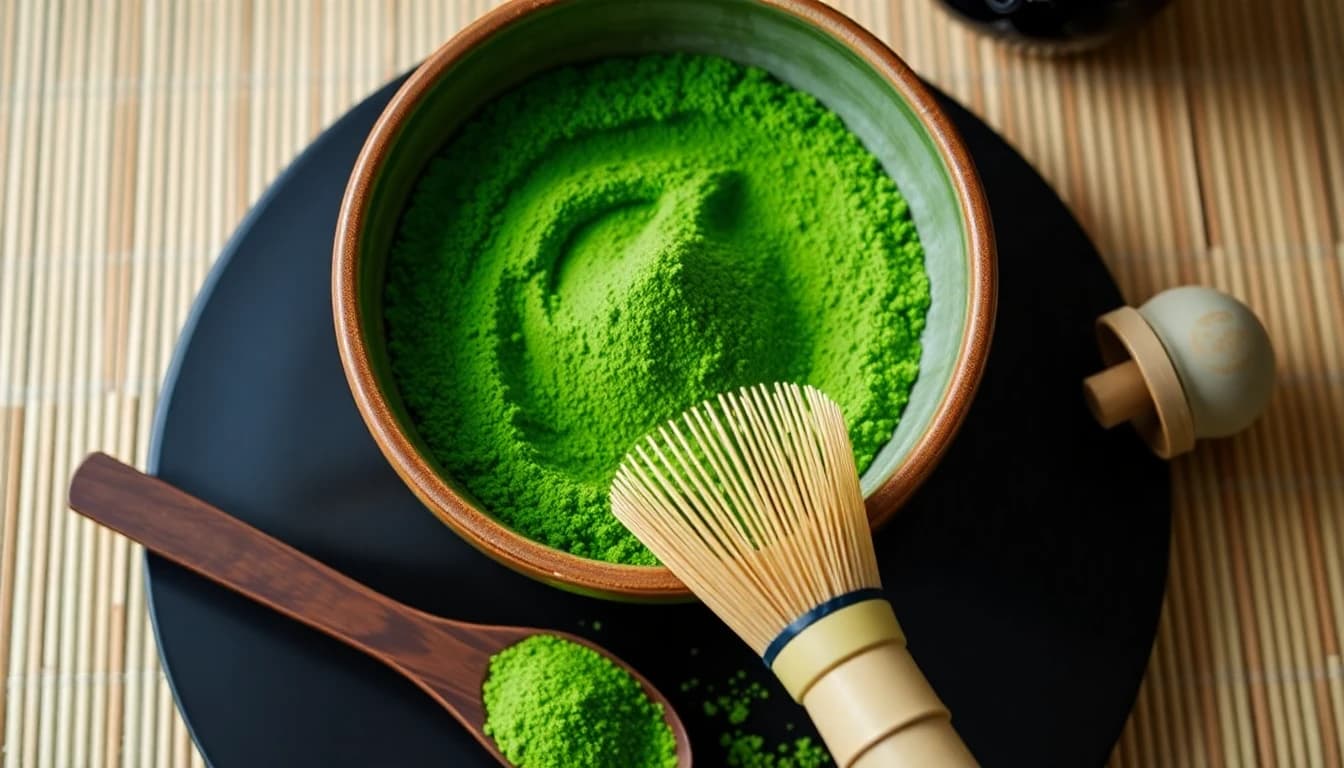
Matcha is not brewed. It is consumed whole. Shade-grown tencha leaves are de-stemmed, de-veined, and stone-ground into an ultra-fine powder at roughly 40 grams per hour. You dissolve the powder directly in hot water and drink the entire leaf -- every antioxidant, every amino acid, every milligram of caffeine.
This full-leaf consumption is what separates matcha from every other tea. You are not extracting flavor from a leaf. You are ingesting the leaf itself.
- Flavor: Rich umami, vegetal sweetness, creamy body. Bitterness varies by grade
- Caffeine: 60-70 mg per serving (roughly equivalent to espresso)
- L-theanine: Highest of all tea types due to extended shading. Promotes calm alertness
- Color: Vivid, electric green (the brighter the green, the higher the grade)
- Price range: $15-$40 (culinary) to $30-$80 (ceremonial) per 30g tin
2. Sencha -- The Everyday Standard
Sencha is what most Japanese people drink most days. The leaves are steamed, rolled, and dried in their whole-leaf form, then steeped in hot water. It accounts for over half of all Japanese tea production, and for good reason: sencha is approachable, versatile, and endlessly varied.
The quality spectrum is enormous. A commodity sencha sold in convenience-store bottles bears little resemblance to a hand-picked shincha (first flush) from a family farm in Shizuoka. The difference is comparable to box wine versus a single-vineyard Burgundy.
- Flavor: Bright, grassy, slightly astringent. Good sencha balances sweetness and bitterness
- Caffeine: 30-50 mg per cup
- Color: Clear yellow-green
- Price range: $5-$15 (standard) to $20-$50 (premium shincha) per 100g
3. Gyokuro -- The Shade-Grown Treasure
Gyokuro is the rarest and most expensive of Japan's standard teas. Like matcha, gyokuro bushes are shaded for 20-30 days before harvest, which forces the plant to produce more chlorophyll and L-theanine while suppressing catechins (the compounds responsible for bitterness). The result is a tea of extraordinary sweetness and umami depth.
But unlike matcha, gyokuro is a whole-leaf tea. You steep it -- you do not grind and dissolve it. The brewing method is deliberately slow: low temperature, small volume, long steep. A proper cup of gyokuro is more akin to a concentrated broth than a casual drink.
- Flavor: Intense umami, marine sweetness, almost savory. Often described as "broth-like"
- Caffeine: 120-140 mg per cup (highest of any tea due to shading + concentrated brewing)
- Color: Deep, opaque green
- Price range: $25-$80 (standard) to $100-$300+ (competition grade) per 100g
4. Hojicha -- The Roasted Comfort
Hojicha breaks every expectation of Japanese green tea. The leaves (usually bancha or sencha) are roasted at high temperatures until they turn reddish-brown, producing a warm, nutty, caramel-like flavor with almost no bitterness and very low caffeine.
In Japan, hojicha is the tea you give to children, the elderly, and anyone recovering from illness. Its gentle nature makes it the most forgiving Japanese tea to brew -- almost impossible to ruin.
- Flavor: Warm, toasty, caramel, light chocolate. No bitterness
- Caffeine: 7-15 mg per cup (the roasting process reduces caffeine content)
- Color: Warm amber-brown
- Price range: $5-$15 per 100g (hojicha is rarely expensive)
5. Bancha -- The Honest Workhorse
Bancha is sencha's unpretentious sibling. Made from larger, more mature leaves harvested later in the season (second or third flush rather than first), bancha has a straightforward, slightly woody flavor with gentle astringency. It is the tea that Japanese households keep in the kitchen for constant refills throughout the day.
Its low caffeine content and mild flavor make bancha a practical choice for those who drink tea in volume. It is also the base material for many hojicha and genmaicha (tea with roasted rice) blends.
- Flavor: Mild, woody, lightly astringent. Clean and simple
- Caffeine: 10-20 mg per cup
- Color: Pale yellow-green
- Price range: $3-$10 per 100g
Tea Terroir: Japan's Four Great Tea Regions
Geography shapes tea the way it shapes wine. Altitude, rainfall, soil composition, and temperature all imprint themselves on the leaf. Japan's four most significant tea-growing regions each produce teas with distinct character.
Uji (Kyoto) -- The Spiritual Origin
Uji is where Japanese tea culture was born. The region's morning mists, mineral-rich soil, and centuries of accumulated knowledge make it the most prestigious name in Japanese tea. When a tea ceremony school selects its matcha, it almost always begins with Uji.
- Signature style: Refined, elegant, layered. Uji matcha has a balanced sweetness with floral top notes
- Famous for: Matcha, gyokuro, sencha
- Heritage: Continuous production since the 12th century. Home to Marukyu Koyamaen (est. 1704) and Ippodo (est. 1717)
- Price premium: 20-40% above national average for equivalent grades
- Best for: Ceremonial matcha, gift-giving, collectors seeking provenance
Yame (Fukuoka) -- The Sweet Whisper
Yame, nestled in the mountains of Fukuoka Prefecture on Kyushu, produces some of Japan's sweetest and most luxurious teas. The region's traditional shading methods, combined with mineral-rich water and significant temperature variation between day and night, create teas with remarkable natural sweetness and virtually zero bitterness.
Yame gyokuro consistently wins Japan's national tea competitions. The region's production volume is small, which keeps prices high and availability limited outside Japan.
- Signature style: Intensely sweet, vegetal, broth-like. Almost zero bitterness
- Famous for: Gyokuro (competition-winning), high-grade matcha
- Heritage: Tea cultivation since the 15th century
- Price premium: Yame gyokuro commands the highest prices in Japan -- $80-$300+ per 100g for top grades
- Best for: Those who dislike bitterness in tea. Gyokuro connoisseurs
Shizuoka -- The Production Powerhouse
Shizuoka is to Japanese tea what Bordeaux is to French wine: the largest producer, the most recognized name internationally, and the region that sets the commercial standard. The prefectures terraced hillsides along the Abe and Oi rivers produce a clean, balanced sencha that represents the archetype of Japanese green tea.
Until 2024, Shizuoka was Japan's top tea-producing prefecture. It still leads in sencha and is home to thousands of tea farms ranging from small family operations to large-scale cooperatives.
- Signature style: Clean, balanced, classic. Shizuoka sencha is the baseline against which other senchas are measured
- Famous for: Sencha (especially from the Kawane and Makinohara districts), fukamushi-cha (deep-steamed tea)
- Heritage: Large-scale production since the Meiji era (1868-)
- Price premium: Moderate. Shizuoka's scale keeps prices competitive
- Best for: Everyday drinking, sencha purists, first-time Japanese tea buyers
Kagoshima -- The Rising Giant
Kagoshima, at the southern tip of Kyushu, has quietly become Japan's largest tea-producing prefecture. The warm climate, volcanic soil from Mount Sakurajima, and modern farming techniques allow earlier harvests and efficient production. Kagoshima teas tend to be smoother and creamier than their Shizuoka counterparts.
The region has invested heavily in matcha production, making it a primary source for the international matcha market. Kagoshima matcha offers excellent quality at more accessible prices than Uji or Yame.
- Signature style: Creamy, smooth, crowd-pleasing. Less astringent than Shizuoka
- Famous for: Matcha (volume production), sencha, kabusecha (partially shaded tea)
- Heritage: Rapid expansion since the 1960s. Now Japan's largest producing region by volume
- Price premium: Lower than Uji and Yame. Kagoshima offers the best quality-to-price ratio in Japanese tea
- Best for: Those who want quality matcha without the Uji premium. Daily drinkers seeking smooth, easy tea
Understanding Matcha Grades
Walk into any tea shop and you will encounter two terms: "ceremonial grade" and "culinary grade." These labels are ubiquitous, commercially useful, and -- it must be said -- entirely invented by marketers.
That said, the distinction is not meaningless. It reflects real differences in production that affect flavor, color, and price. Here is what the terms actually indicate.
Ceremonial Grade (Drinking Matcha)
- Harvest: First flush only (spring, typically May)
- Shading: 20-30 days under traditional tana (shelf-style) canopies or modern netting
- Milling: Granite stone-milled at approximately 40g per hour -- slow enough to prevent heat damage
- Leaf: Youngest leaves from the top of the bush, stems and veins fully removed
- Color: Vivid, electric green. If it looks dull or yellowish, it is not ceremonial grade
- Taste: Sweet, umami-rich, with a smooth, creamy finish. Minimal bitterness
- Use: Whisked with water and consumed straight (usucha or koicha)
- Price: $25-$80 per 30g tin ($0.80-$2.50 per serving)
Culinary Grade (Cooking/Blending Matcha)
- Harvest: Second or third flush (summer or autumn)
- Shading: Shorter shading period, sometimes none
- Milling: Larger-scale milling, sometimes ball-milled rather than stone-ground
- Leaf: Older leaves, may include some stem material
- Color: Yellow-green to olive. Noticeably less vibrant than ceremonial
- Taste: More bitter, more astringent, less umami. This is a feature, not a bug -- the stronger flavor cuts through milk, sugar, and batter
- Use: Lattes, smoothies, baking, ice cream, chocolate
- Price: $10-$25 per 30-100g ($0.10-$0.50 per serving)
What Actually Determines Quality
If the two-tier system is a simplification, what should you actually look for? Five factors matter more than any label on the tin.
- Color: The single most reliable visual indicator. Premium matcha is vivid, almost neon green. This comes from high chlorophyll content produced by extended shading. Dull, brownish, or yellowish matcha was either poorly shaded, oxidized, or old
- Aroma: Fresh matcha smells like sweet grass and cream. Stale or low-grade matcha smells flat, hay-like, or musty
- Origin: Uji and Yame consistently produce the finest matcha. Kagoshima offers excellent value. Be cautious with matcha that does not specify its prefecture of origin
- Texture: Rub a small amount between your fingers. True stone-ground matcha feels like talcum powder -- particle size under 10 microns. Gritty matcha was likely ball-milled
- Freshness: Matcha begins degrading the moment it is ground. Buy from vendors who stone-mill to order or can confirm a recent milling date. Once opened, use within 4-6 weeks and store refrigerated in an airtight, opaque container
Notable Producers and Where to Buy
Heritage Brands (Centuries of Production)
Marukyu Koyamaen (est. 1704, Uji)
The gold standard for ceremonial matcha. Marukyu Koyamaen supplies tea to Japan's most prestigious temples, shrines, and tea schools. Their matcha portfolio ranges from approachable daily grades to competition-winning rarities that sell for over $100 per 20g tin. Their tencha processing facility in Uji is one of the most advanced in Japan, yet the stone-milling remains traditional. The brand offers international shipping through their official online shop and authorized retailers (Source: Marukyu Koyamaen Official).
- Range: $15-$120+ per 20-40g
- Best for: Serious matcha drinkers, gift-giving, tea ceremony
Ippodo Tea (est. 1717, Kyoto)
Ippodo has been selling tea from the same Kyoto storefront for over three centuries. Their matcha range is clearly tiered from introductory to ultra-premium, with descriptive names that indicate intensity and sweetness. Ippodo's retail experience -- both in their Kyoto and Tokyo tea rooms and via their English-language website -- is among the best in the industry for international buyers (Source: Ippodo Tea Official).
- Range: $15-$70 per 20-40g
- Best for: First-time buyers who want a guided progression from entry to premium
Hoshino Seichaen (Yame, Fukuoka)
Specialists in Yame tea -- arguably the sweetest matcha produced anywhere in Japan. Hoshino Seichaen's gyokuro and matcha consistently place in national competitions. Their products are less widely available internationally than Uji brands, which adds to their mystique and exclusivity.
- Range: $20-$90+ per 30-40g
- Best for: Gyokuro enthusiasts, those who prize sweetness over astringency
Modern Producers (Quality at Scale)
Encha (sourced from Uji)
A direct-to-consumer brand that sources from organic farms in the Uji mountains. Encha focuses on transparency: single-origin, first-harvest, organic certification. Their packaging and branding target Western consumers who want quality without navigating Japanese-language websites.
- Range: $20-$35 per 30-60g
- Best for: International buyers seeking certified organic matcha with clear sourcing
Jade Leaf (sourced from Kagoshima and Uji)
One of the best-selling matcha brands in the United States. Jade Leaf works directly with family farms in Kagoshima and Uji, offering both ceremonial and culinary grades at competitive prices. Their culinary-grade matcha is a strong choice for daily lattes and baking.
- Range: $10-$30 per 30-100g
- Best for: Daily matcha drinkers, latte lovers, home bakers on a budget
How to Brew Japanese Tea
Brewing Japanese tea is not complicated, but it is precise. Temperature and timing matter more than quantity. A few degrees too hot, and your delicate gyokuro becomes a bitter disappointment.
Matcha Preparation
Sencha Brewing
- Leaves: 5-8g per cup (roughly 1 tablespoon)
- Water temperature: 70-80 degrees Celsius (158-176 degrees Fahrenheit)
- Steep time: 60-90 seconds for the first infusion
- Second infusion: Slightly hotter water, 10-15 seconds only
- Third infusion: Near-boiling water, 30 seconds
- Tip: Pour out every drop. Leaving water on the leaves between infusions over-steeps and kills the second cup
Gyokuro Brewing
- Leaves: 7-8g per cup (roughly 1.5 tablespoons -- use more than sencha)
- Water temperature: 50-60 degrees Celsius (122-140 degrees Fahrenheit). This is critical. Gyokuro brewed too hot tastes harsh
- Steep time: 90-120 seconds for the first infusion
- Volume: Only 30-40ml per serving. Gyokuro is concentrated, not voluminous
- Cooling method: Boil water, pour into one cup, wait, transfer to a second cup. Each transfer drops the temperature by roughly 10 degrees Celsius (Source: Tezumi Brewing Guide)
Hojicha and Bancha Brewing
- Leaves: 5-8g per cup
- Water temperature: 90-100 degrees Celsius (near-boiling is fine)
- Steep time: 30-60 seconds
- Note: These are the most forgiving teas to brew. Boiling water will not ruin them. This makes hojicha an excellent starting point for people who find green tea intimidating
Essential Tea Equipment
Japanese tea requires less equipment than you might expect. Three items cover everything.
- Kyusu (side-handle teapot): The defining vessel of Japanese tea. A kyusu's built-in mesh filter keeps leaves in the pot while allowing you to pour cleanly. Tokoname clay kyusu from Aichi Prefecture are the standard -- the iron-rich clay mellows the tea's astringency. Prices range from $25 to $200+. See our pottery guide for more on Japanese clay traditions
- Chasen (bamboo tea whisk): Essential for matcha. Handmade in Takayama, Nara Prefecture, by fewer than two dozen remaining artisans. A proper chasen has 80-120 fine tines carved from a single piece of bamboo. Expect to pay $15-$35 and replace it every 3-6 months with regular use
- Chawan (tea bowl): A matcha bowl is wider and shallower than a typical cup, designed to accommodate the whisking motion. Any Japanese pottery style works -- Raku, Hagi, and Mino are traditionally favored for tea ceremony. Prices range from $20 for functional ware to thousands for named artisan pieces
Hiro's Daily Matcha Practice
Every morning, before checking messages or opening a laptop, I prepare a bowl of matcha. The ritual takes four minutes. It has become the most non-negotiable part of my day.
I use a mid-range ceremonial-grade matcha from a Uji producer -- nothing extravagant, roughly $30 per 30g tin. The key is freshness: I order monthly and store the tin sealed in the refrigerator. The chasen sits in a ceramic whisk holder between uses, which preserves the shape of the tines.
The preparation itself is the point. Sifting the powder forces you to slow down. Heating the water to precisely the right temperature requires attention. The whisking motion engages your wrist in a rhythm that is almost meditative. By the time I lift the bowl and take the first sip, I have had three minutes of forced presence before the day begins.
The effect is different from coffee. The caffeine arrives gradually, sustained by L-theanine into a calm focus that lasts roughly four hours without the afternoon crash. I surf in the mornings, practice Ashtanga yoga four times a week, and find that matcha supports both -- it energizes without agitating.
If you are new to matcha, start with a culinary-grade powder in a latte. Move to ceremonial grade whisked with water when you are curious. The full sensory experience of drinking matcha straight -- the umami, the foam, the electric green color -- is worth arriving at gradually.
How to Store Japanese Tea
Tea is fragile. Light, heat, moisture, and oxygen are its enemies. Here is how to protect your investment.
- Matcha: Store unopened tins in the refrigerator. Once opened, use within 4-6 weeks. Re-seal tightly after each use. Never freeze matcha -- condensation on thawing degrades the powder
- Sencha and gyokuro: Store in an airtight, opaque container at room temperature. Use within 2-3 months of opening. Vacuum-sealed, unopened sencha keeps for up to a year
- Hojicha and bancha: The most resilient. Store in a sealed container away from sunlight. Good for 3-6 months after opening
- General rule: Never store tea near spices, coffee, or anything aromatic. Tea absorbs surrounding odors readily
Frequently Asked Questions
Where to Go Next
Japanese tea connects to nearly every craft tradition we cover. The chawan you drink matcha from is a work of pottery -- explore our Japanese pottery comparison guide to find a bowl that speaks to you. The lacquered tea caddies (natsume) used in tea ceremony share techniques with Wajima lacquerware. And if your tea journey leads you to Japan itself, our guides to hidden artisan towns and Kyoto's craft walks will take you to the farms and workshops where these teas are grown and processed.
Tea is not the end of the journey. It is the beginning.
Written by Hiro Miyamoto
Founder & CEO of Scratch Second. Starting from corporate sales at a South American food supplier, Hiro went on to spearhead the Japan market launch as VP of Sales at a Silicon Valley foodtech company — placing products in 2,400+ convenience stores and supplying ingredients for an international expo. He currently leads business development across Asia at one of the world's largest tech companies. Off the clock, he's a dedicated yachtsman, yogi, and sauna enthusiast who writes about the intersection of modern healthtech and Japan's timeless wellness traditions.
Related Articles
craft
Wajima Lacquerware: Why Japan's Most Resilient Craft Deserves Your Attention
A complete guide to Wajima-nuri lacquerware — the 124-step process, how it compares to other Japanese lacquer, what to buy, where to buy, and how Wajima is r...
craft
Japan's Matcha Exports Surpass 10,000 Tons for the First Time in 71 Years
In 2025, Japanese tea exports exceeded 10,000 tons for the first time since 1954. Behind the matcha boom lies a deepening supply shortage, soaring prices, and a structural shift in Japan's tea farming industry.
craft
Why HOSOO Moves the World — A 327-Year-Old Nishijin Weaver's Path to Dior and Chanel
How HOSOO, a 327-year-old Nishijin-ori weaving house in Kyoto, became the textile supplier to Dior, Chanel, and Hermes. An in-depth look at their 150cm-wide loom innovation, LVMH partnership, and Milan expansion.