
craft · 8min read · 2026-04-06
Wajima Lacquerware: Why Japan's Most Resilient Craft Deserves Your Attention
A complete guide to Wajima-nuri lacquerware — the 124-step process, how it compares to other Japanese lacquer, what to buy, where to buy, and how Wajima is r...
Key Takeaways
- Each Wajima-nuri piece passes through approximately 124 handmade steps
- Jinoko diatomaceous earth undercoat is unique to Wajima and gives exceptional durability
- The 2024 Noto earthquake destroyed 13 workshops and damaged 50 more
- Wajima lacquerware lasts over 100 years and is fully repairable when damaged
- Maki-e gold powder painting and chinkin gold engraving are the two decoration styles
On New Year's Day 2024, a magnitude 7.6 earthquake struck the Noto Peninsula. Workshops that had lacquered wood for centuries collapsed in seconds. Fifty of the 103 companies affiliated with the Wajima-nuri Commerce and Industry Cooperative were completely or partially destroyed. Thirteen were lost entirely.
And yet, within months, artisans were back at their benches. Some worked from temporary studios in Kanazawa. Others rebuilt in place, salvaging tools from rubble. Wajima lacquerware has survived fires, wars, and economic upheaval across six centuries. The earthquake was devastating — but not final.
This guide covers everything you need to know about Wajima-nuri: what makes it different from every other lacquerware tradition, how to buy authentic pieces, and how your purchase directly supports a community in recovery.
What Is Wajima Lacquerware? A Quick Overview
Wajima-nuri (輪島塗) is a traditional lacquerware craft produced in Wajima City, Ishikawa Prefecture, on the Noto Peninsula of Japan. It holds official designation as a Japanese Traditional Craft Product — one of only 23 lacquerware traditions still recognized by the government.
Key facts at a glance:
- Origin: Muromachi period (1336-1573), over 600 years of continuous production
- Location: Wajima City, Ishikawa Prefecture, Noto Peninsula
- Process: Approximately 124 handmade steps, completed by specialized artisans
- Defining material: Jinoko (地の粉) -- powdered diatomaceous earth unique to Wajima
- Lifespan: 100+ years with proper care; fully repairable when scratched or chipped
- Price range: $30 (chopsticks) to $5,000+ (large decorative pieces)
- Decoration styles: Maki-e (gold powder painting) and Chinkin (gold-inlaid engraving)
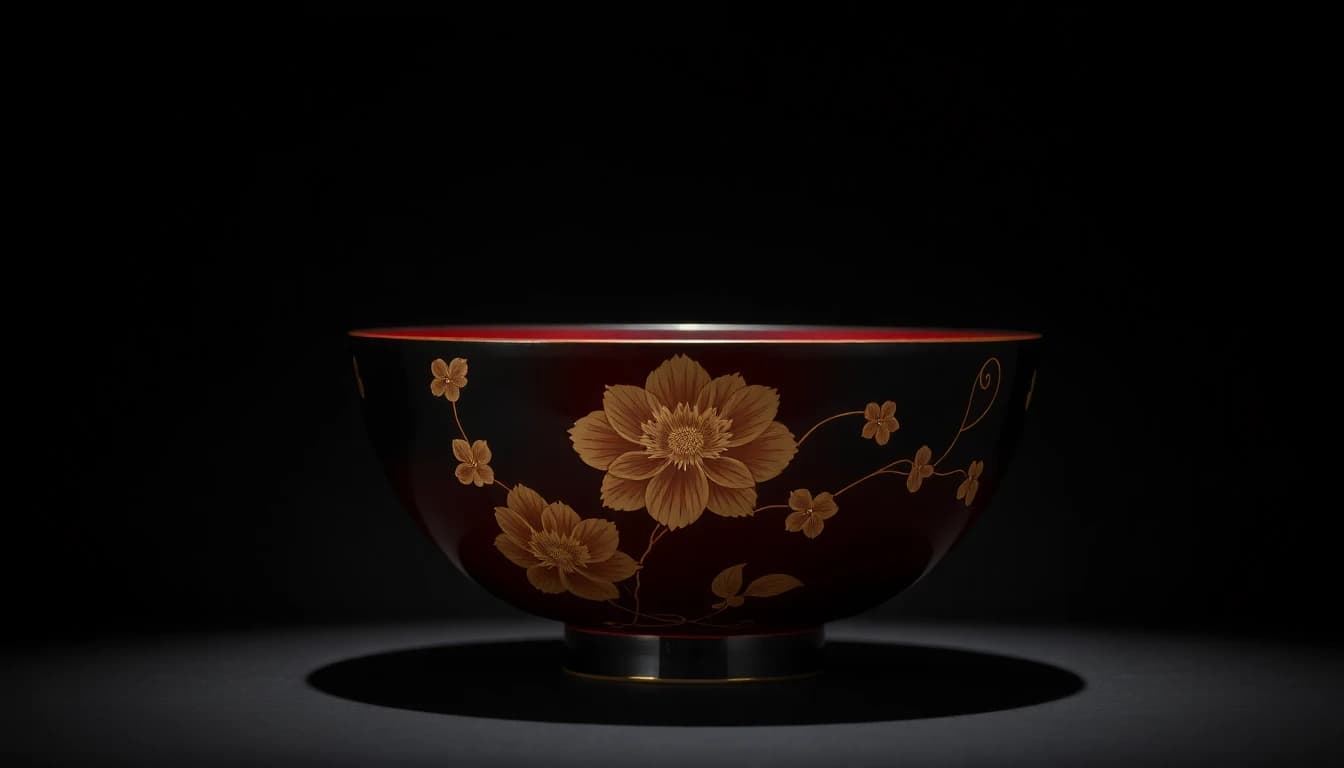
What struck me first when I visited a Wajima workshop was the weight. Not heaviness — substance. A Wajima soup bowl feels dense with intention. Each layer of lacquer is invisible but present, the way a building's foundation is felt in its stability rather than seen.
- Official name -- Wajima-nuri (輪島塗)
- Prefecture -- Ishikawa
- UNESCO status -- Part of Japan's Traditional Craft Products system
- Active workshops (pre-2024) -- 103 companies in the Wajima-nuri Cooperative
- Key material -- Jinoko (diatomaceous earth) + natural urushi sap
- Typical production time -- 3-6 months per piece
The 124-Step Process — Simplified Into 5 Key Stages
Every Wajima piece passes through approximately 124 individual steps. No single artisan completes the entire process. Wajima operates on a strict division of labor — each specialist handles one stage before passing the piece to the next.
Here are the five essential stages:
1. Wood shaping (Kiji)
- What happens: Japanese zelkova or cypress wood is turned on a lathe or carved by hand. The raw wood is dried for 1-3 years before shaping.
- Why it matters: The foundation of durability. Poorly dried wood warps over time.
2. Cloth reinforcement (Nunokise)
- What happens: Fine hemp or cotton cloth is glued to stress points -- rims, bases, joints -- using raw lacquer as adhesive.
- Why it matters: Prevents cracking at the points where lacquerware fails first.
3. Jinoko undercoating (Shitaji)
- What happens: Multiple layers of urushi mixed with jinoko (diatomaceous earth) are applied and sanded. This stage alone involves 20+ coats.
- Why it matters: The secret to Wajima's durability. Jinoko creates a rock-hard base that other lacquerware traditions lack.
4. Lacquer finishing (Uwanuri)
- What happens: Pure refined urushi is applied in thin, even layers. Each coat must cure in a humidity-controlled room (70-80% humidity) for 24-48 hours before sanding and recoating.
- Why it matters: Urushi cures through oxidation and humidity -- not drying. Wajima's coastal climate is naturally ideal.
5. Decoration (Keshoku)
- What happens: Maki-e: gold or silver powder sprinkled onto wet lacquer to create designs. Chinkin: patterns engraved into cured lacquer and filled with gold leaf or powder.
- Why it matters: Decoration is the final 10% of the process but often 50%+ of the price. Master maki-e artists train for decades.
!!The 124 steps are not ceremonial tradition for tradition's sake. Each one solves a specific engineering problem -- moisture resistance, crack prevention, surface hardness, UV protection. Wajima-nuri is over-engineered by design.
Why Wajima Stands Apart — Comparison With Other Japanese Lacquerware
Japan has 23 officially recognized lacquerware traditions. Three dominate the market: Wajima, Yamanaka, and Echizen. Here is how they compare.
1. Wajima-nuri
- Location: Wajima, Ishikawa
- Signature technique: Jinoko undercoating (20+ layers)
- Durability: Highest -- 100+ year lifespan, fully repairable
- Decoration: Maki-e and chinkin (gold work)
- Weight: Heavier (multiple undercoat layers)
- Price range: $30 -- $5,000+
- Best for: Heirloom pieces, collectors, lifetime investment
2. Yamanaka-nuri
- Location: Kaga, Ishikawa
- Signature technique: Kashoku-biki woodturning (40+ decorative patterns)
- Durability: High -- wood grain visible, lighter construction
- Decoration: Gold/silver maki-e on visible wood grain
- Weight: Lighter (thinner lacquer, wood grain exposed)
- Price range: $20 -- $2,000+
- Best for: Elegant daily use, tea ceremony, those who love natural wood
3. Echizen-nuri
- Location: Sabae, Fukui
- Signature technique: Fuki-urushi (wiping lacquer for natural wood grain)
- Durability: Moderate to high -- practical daily-use focus
- Decoration: Shunkei-nuri (transparent lacquer), roiro-nuri (glossy black)
- Weight: Light to medium
- Price range: $15 -- $1,000+
- Best for: Affordable daily lacquerware, restaurant use
iThe critical difference is jinoko. Only Wajima uses diatomaceous earth in its undercoating. This material, mined locally on the Noto Peninsula, creates a base coat so hard that Wajima pieces can be repaired indefinitely. A cracked Yamanaka or Echizen piece is usually retired. A cracked Wajima piece goes back to the workshop, gets re-lacquered, and returns to service. This is not a craft you replace. It is a craft you pass down.
After the Earthquake — Wajima's Recovery Story
The facts first, because they matter.
2024 Noto Peninsula Earthquake — Impact on Wajima Lacquerware
- Date: January 1, 2024
- Magnitude: 7.6
- Workshops destroyed: 13 of 103 cooperative members lost entirely
- Workshops damaged: 50 completely or partially destroyed; nearly all others sustained damage
- Displacement: Many artisans relocated to Kanazawa and other cities
The Wajima-nuri community's response was immediate and characteristic. Within weeks, temporary workshops were established. The Ceramic Art Center Lacquerware (CACL) in Nomi opened its facilities for displaced artisans. Kanazawa offered subsidies of up to 500,000 yen (approximately $3,300) for artisans setting up new studios — no repayment required (Source: KOGEI STANDARD, 2024).
Where things stand now:
- Wajima Kobo Nagaya (the artisan workshop complex) has resumed tours and hands-on experiences since June 2024
- Most artisans who relocated to Nomi have returned to Wajima
- One artisan, Keizuka Hidenobu, chose to establish a permanent workshop in Nomi -- a sign that the craft is spreading, not just recovering
- The gallery Urushi no Sato Ofuji opened in Kanazawa as both a retail space and a reconstruction operations base
- International attention has increased -- The Japan Society hosted a lecture on "Craft in Crisis" and multiple media outlets have covered the recovery
When I returned to Wajima after the earthquake, the landscape had changed but the rhythm of the workshops had not. Lacquer was still being applied in thin, patient coats. The division of labor — each artisan handling one stage — meant that even with reduced capacity, production could continue. The system that makes Wajima-nuri slow to produce also makes it resilient to disruption.
“Buying Wajima lacquerware now is not charity. It is commerce that sustains recovery. Every purchase keeps the supply chain alive
Every purchase keeps the supply chain alive — the urushi tappers, the jinoko miners, the wood turners, the lacquerers, the maki-e decorators. When you buy a Wajima bowl, you are funding a reconstruction measured not in months but in generations.
What to Buy — A Buyer's Guide
Price Guide
- Chopsticks (pair) -- $30 -- $200. Entry point. Hand-lacquered, often with gold leaf details. Couples sets available.
- Rice/soup bowls -- $80 -- $400. Daily-use workhorse. Lidded soup bowls (wan) are the signature Wajima form.
- Sake cups (sakazuki) -- $50 -- $300. Small but heavily lacquered. Maki-e decorated cups at the higher end.
- Trays (bon) -- $150 -- $800. Serving trays with deep lacquer finish. Larger pieces command higher prices.
- Tea caddies (natsume) -- $200 -- $2,000+. Tea ceremony pieces with elaborate maki-e or chinkin decoration.
- Decorative boxes/panels -- $500 -- $5,000+. Collector pieces. Master artisan maki-e work at the top of the range.
*A pair of Wajima-nuri chopsticks ($30-80) or a single soup bowl ($80-150) is the best value entry point. These are functional pieces you will use daily, and they demonstrate the quality difference immediately.
How to Spot Authentic Wajima-nuri — Checklist
Counterfeits and mislabeled lacquerware exist. Use this checklist before buying:
- Cooperative certification: Look for the Wajima-nuri Commerce and Industry Cooperative mark or certificate of authenticity
- Named artisan or workshop: Authentic pieces identify the maker. If the seller cannot tell you who made it, proceed with caution
- Weight test: Genuine Wajima-nuri feels heavier than other lacquerware due to the multiple jinoko undercoat layers
- Repair guarantee: Legitimate Wajima workshops offer repair services. Ask if the piece can be sent back for re-lacquering
- Material declaration: Authentic Wajima uses natural urushi, jinoko, and solid wood (zelkova or cypress). Synthetic lacquer or MDF base = not authentic
- Price reality check: If a "Wajima-nuri" bowl costs under $50, it is almost certainly machine-made or uses synthetic materials. The 124-step process has a floor cost
- Traditional Craft Product mark: Japan's official designation system -- look for the seal on packaging
Where to Buy
Online (international shipping):
- THE WAJIMA by SENSHUDO -- Official Japanese retailer, direct from Wajima artisans
- Wajima Kirimoto via Nihon Ichiban -- 7th-generation family workshop, worldwide shipping
- Kogei Styling -- Curated Wajima-nuri collection with detailed provenance
- Musubi Kiln -- Broader Japanese craft retailer with a Wajima section
- The Chopstick Company -- Specializes in Wajima lacquer chopsticks
In Japan:
- Wajima Kobo Nagaya (Wajima City) -- Workshop tours + direct purchase + hands-on gold-leaf chopstick customization
- Urushi no Sato Ofuji (Kanazawa) -- Gallery opened by a displaced Wajima artisan; doubles as a reconstruction hub
- Wajima Morning Market (Wajima City) -- Over 200 stalls, including lacquerware vendors. One of Japan's oldest morning markets
- Wajima Lacquerware Museum (Wajima City) -- Museum shop with certified pieces
For more Japanese craft disciplines and where to find them, explore our Craft collection and all craft articles.
Care and Maintenance — Keep It Simple
Wajima lacquerware is built for daily use, not display cases. But natural urushi does have specific needs. Follow these guidelines and your pieces will last a lifetime — literally.
Do:
- Hand wash with lukewarm water and a soft sponge
- Use mild dish soap -- modern urushi finishes handle it well
- Dry immediately with a soft cloth after washing
- Store in a cupboard away from direct sunlight (UV degrades urushi over time)
- Use your lacquerware regularly -- urushi actually improves with use as the surface continues to cure
- Wrap individual pieces in soft cloth if stacking to prevent surface scratches
Do not:
- Put in the dishwasher (heat + detergent concentration damages the lacquer)
- Use in the microwave (wood base + lacquer coating are not microwave-safe)
- Soak for extended periods (prolonged water exposure can affect the wood base)
- Expose to direct sunlight for storage (UV causes color fading over decades)
- Use abrasive sponges or scouring pads (scratches the surface finish)
For a deeper dive into Japanese craft care practices, see our kitchen knives care guide, which covers similar principles of maintenance and longevity.
Frequently Asked Questions
What makes Wajima lacquerware different from other Japanese lacquerware?
The defining difference is the jinoko undercoating. Wajima is the only Japanese lacquerware tradition that uses powdered diatomaceous earth (mined locally on the Noto Peninsula) mixed with urushi to create an exceptionally hard base layer. This undercoating, applied in 20 or more coats, gives Wajima-nuri its superior durability and its unique ability to be fully repaired and re-lacquered indefinitely.
Is Wajima lacquerware safe to use with food?
Yes. Fully cured natural urushi is food-safe and has been used for tableware in Japan for centuries. Urushi has natural antibacterial properties and provides excellent heat insulation — a Wajima soup bowl stays comfortable to hold even with hot miso inside. Avoid using pieces that show exposed bare wood through deep chips until they have been repaired.
How long does Wajima lacquerware last?
With proper care and occasional re-lacquering, Wajima pieces can last over 100 years. The jinoko undercoating and multiple lacquer layers create a structure designed to endure daily use across generations. Many Japanese families pass Wajima bowls and trays through three or more generations as part of their household. The repairability is the key: unlike most tableware, Wajima-nuri is not disposable.
Can I visit Wajima lacquerware workshops after the 2024 earthquake?
Yes. Wajima Kobo Nagaya has resumed workshop tours and hands-on experiences since June 2024. Visitors can customize chopsticks with gold leaf or gold dust. The Wajima Morning Market is also operational. Infrastructure in the Noto Peninsula is still under repair in some areas, so check current access conditions before traveling. The journey from Kanazawa takes approximately 2 hours by car. For more on traveling this region, see our Japan artisan trail guide.
Where can I buy authentic Wajima lacquerware online with international shipping?
Several reputable retailers ship worldwide. THE WAJIMA by SENSHUDO (thewajima.com) is an official Japanese retailer sourcing directly from Wajima artisans. Wajima Kirimoto, a 7th-generation family workshop, ships globally via Nihon Ichiban. Kogei Styling and Musubi Kiln also offer curated selections with provenance information. Always verify the cooperative certification mark and ask about the specific artisan before purchasing.
Support Wajima — How Your Purchase Helps
Wajima-nuri is not a museum exhibit. It is a living craft sustained by a network of highly specialized artisans — urushi tappers, jinoko processors, wood turners, cloth appliers, undercoaters, finish lacquerers, maki-e painters, and chinkin engravers. Each purchase activates this entire chain.
After the 2024 earthquake, that chain is more fragile than it has been in decades. Workshops are rebuilding. Young artisans are deciding whether to stay or leave. The next five years will determine whether Wajima-nuri emerges stronger or enters a slow decline.
Three ways to support Wajima right now:
- Buy directly from Wajima artisans -- online or in person. Direct purchases return the highest margin to makers
- Visit the Noto Peninsula -- tourism revenue supports the broader community. Wajima Kobo Nagaya offers workshop experiences that put money directly into artisan hands
- Share the story -- awareness drives demand. The more people know about Wajima-nuri, the more sustainable its recovery becomes
For more ways to engage with Japanese craft traditions, explore our full craft collection and our Japan artisan trail guide for planning craft-focused travel.
Written by Hiro Miyamoto
Founder & CEO of Scratch Second. Starting from corporate sales at a South American food supplier, Hiro went on to spearhead the Japan market launch as VP of Sales at a Silicon Valley foodtech company — placing products in 2,400+ convenience stores and supplying ingredients for an international expo. He currently leads business development across Asia at one of the world's largest tech companies. Off the clock, he's a dedicated yachtsman, yogi, and sauna enthusiast who writes about the intersection of modern healthtech and Japan's timeless wellness traditions.
Related Articles
craft
Japan's Matcha Exports Surpass 10,000 Tons for the First Time in 71 Years
In 2025, Japanese tea exports exceeded 10,000 tons for the first time since 1954. Behind the matcha boom lies a deepening supply shortage, soaring prices, and a structural shift in Japan's tea farming industry.
craft
Why HOSOO Moves the World — A 327-Year-Old Nishijin Weaver's Path to Dior and Chanel
How HOSOO, a 327-year-old Nishijin-ori weaving house in Kyoto, became the textile supplier to Dior, Chanel, and Hermes. An in-depth look at their 150cm-wide loom innovation, LVMH partnership, and Milan expansion.
craft
Sake's UNESCO Moment — How Heritage Status Is Fueling a Global Export Surge
Japan's traditional sake-brewing was inscribed on UNESCO's Intangible Cultural Heritage list in December 2024. In 2025, sake exports reached 45.9 billion yen across a record 81 countries. A deep dive into the premium sake boom and the challenges facing Japan's breweries.