
craft · 15min read · 2026-03-09
The Complete Guide to Japanese Kitchen Knives: Everything You Need to Know
The definitive guide to Japanese kitchen knives. Knife types, steel, regions, how to choose, where to buy, and care tips for 2026.
Key Takeaways
- Japanese knives reach HRC 60-67 hardness versus 54-58 for Western knives
- Blade geometry of 10-15 degrees per side creates less cutting resistance
- Sakai, Seki, and Tsubame-Sanjo are the three major production regions
- Gyuto, Santoku, Yanagiba, Deba, and Usuba are the five main knife types
- Clean knife cuts preserve cell structure, improving sashimi taste and texture
A Japanese kitchen knife is not just a tool. It is a continuation of a sword-making tradition that stretches back over 700 years. Where Western knives rely on weight and rocking motions, Japanese blades achieve precision through geometry: thinner profiles, harder steel, and acute edge angles that glide through ingredients rather than forcing through them.
Whether you are a home cook upgrading from a dull supermarket blade or a professional chef seeking surgical control, this guide covers everything you need to know. We walk through the major knife types, the steel that defines their performance, the regions where they are forged, and how to choose, buy, and maintain your first (or next) Japanese knife.
At Scratch Second, we work directly with Japanese artisans and knife-makers. What follows draws on visits to workshops in Seki and Sakai, conversations with blacksmiths, and years of daily use.
What Makes Japanese Kitchen Knives Special?
Japanese knives differ from their Western counterparts in three fundamental ways: steel hardness, blade geometry, and the philosophy behind the cut.
Harder Steel, Sharper Edge
Most Western knives sit between 54 and 58 on the Rockwell Hardness Scale (HRC). Japanese blades routinely reach 60 to 67 HRC. Harder steel holds a sharper edge for longer. The trade-off is brittleness: drop a Japanese knife on tile, and the edge may chip where a softer German blade would simply dent.
Thinner Geometry
Japanese blades are ground thinner, often at 10 to 15 degrees per side compared to 20 degrees on a typical Western knife. This reduced angle creates less resistance. A thin Nakiri slips through a daikon radish with almost no effort. A German chef knife requires more force for the same cut.
Philosophy of Precision
In Japanese culinary culture, how you cut an ingredient affects its flavor and texture. The knife is an instrument of respect for the ingredient.
Types of Japanese Kitchen Knives
Japanese kitchen knives fall into two broad families: wa-bocho (Japanese-style, often single-bevel) and yo-bocho (Western-influenced, double-bevel). Below are the seven types you will encounter most often.
Gyuto: The Japanese Chef's Knife
The Gyuto (literally "cow sword") is the Japanese answer to the French chef's knife. Developed in the late 19th century as Japan opened to Western culinary influences, it has become the most versatile knife in any kitchen.
- Blade length: 180 mm (home) to 270 mm (professional)
- Bevel: Double
- Best for: Meat, fish, vegetables, herbs. Virtually any cutting task.
- Price range: $80 to $400+ (USD)
- Who it's for: Everyone. If you buy one Japanese knife, make it a Gyuto.
Compared to a Western chef's knife, the Gyuto is lighter and thinner. It favors a push-cut or pull-cut motion over the Western rock-chop. A 210 mm Gyuto is the sweet spot for most home cooks.
Santoku: The Versatile All-Rounder
Santoku means "three virtues," referring to its ability to handle meat, fish, and vegetables. Designed for the Japanese home kitchen, it is shorter and lighter than a Gyuto.
- Blade length: 165 to 180 mm
- Bevel: Double
- Best for: Daily home cooking. Quick vegetable prep, slicing boneless protein.
- Price range: $60 to $300 (USD)
- Who it's for: Home cooks who find a Gyuto too large, or anyone who prefers a compact, nimble blade.
The flatter belly of the Santoku encourages an up-and-down chopping motion. If you grew up using a Chinese cleaver or Nakiri, the Santoku will feel intuitive.
Nakiri: The Vegetable Specialist
The Nakiri is a dedicated vegetable knife. Its flat, rectangular blade makes full contact with the cutting board on each stroke, producing clean cuts across the entire edge.
- Blade length: 160 to 180 mm
- Bevel: Double
- Best for: Vegetables exclusively. Julienne, brunoise, paper-thin slices.
- Price range: $50 to $250 (USD)
- Who it's for: Plant-forward cooks, anyone who processes large volumes of vegetables.
A Nakiri will not replace a Gyuto for protein work, but for pure vegetable cutting speed and precision, nothing else comes close.
Yanagiba: The Sashimi Blade
The Yanagiba ("willow blade") is the iconic sushi knife. Its long, slender profile allows a single drawing stroke to slice fish without tearing the delicate flesh.
- Blade length: 240 to 330 mm
- Bevel: Single (right-handed standard; left-handed available at premium)
- Best for: Sashimi, sushi. Precision slicing of raw fish.
- Price range: $100 to $800+ (USD)
- Who it's for: Sushi enthusiasts and professional sushi chefs. Not a daily-driver for most home cooks.
Single-bevel knives require a specific sharpening technique. If you invest in a Yanagiba, plan to invest time in learning whetstone skills, or budget for professional sharpening.
Deba: The Fish Butcher
Where the Yanagiba finishes the job, the Deba starts it. This thick, heavy blade is purpose-built for breaking down whole fish: removing heads, splitting bones, and filleting.
- Blade length: 150 to 210 mm
- Bevel: Single
- Best for: Fish butchery. Breaking down whole fish, cutting through small bones and cartilage.
- Price range: $80 to $500 (USD)
- Who it's for: Anyone who regularly works with whole fish. Essential in Japanese professional kitchens.
The Deba's spine can reach 9 mm thick near the heel. Despite its weight, it is not a cleaver. Use the heel for bones and the tip for delicate fillet work. Never twist the blade sideways.
Petty: The Utility Knife
The Petty is the Japanese paring or utility knife. Small, light, and agile, it handles the detail work that larger knives cannot.
- Blade length: 80 to 150 mm
- Bevel: Double
- Best for: Peeling, trimming, deveining shrimp, small precision cuts.
- Price range: $40 to $200 (USD)
- Who it's for: Everyone. A Petty pairs perfectly with a Gyuto as a two-knife setup.
A 120 mm or 150 mm Petty doubles as a small utility knife for tasks like mincing garlic or segmenting citrus. It is the second knife most professionals recommend after a Gyuto.
Kiritsuke: The Executive's Choice
The Kiritsuke is a hybrid blade that combines the length of a Yanagiba with the versatility of a Gyuto. Traditionally, only the head chef (itamae) in a Japanese kitchen was permitted to use one.
- Blade length: 240 to 330 mm
- Bevel: Single (traditional) or Double (modern K-tip Gyuto variant)
- Best for: A statement knife. Fish slicing and vegetable work in one blade.
- Price range: $150 to $600+ (USD)
- Who it's for: Experienced cooks seeking a do-it-all blade with heritage appeal. The modern double-bevel "K-tip" version is more forgiving for beginners.
If you see a "Kiritsuke" under $100, it is almost certainly a K-tip Gyuto rather than a true single-bevel Kiritsuke. Both are fine knives. Just know which one you are buying.
Understanding Japanese Knife Steel
Steel is the soul of a knife. Two blades with identical shapes will perform entirely differently depending on the steel inside. Here is what you need to know.
Stainless vs Carbon Steel
This is the first fork in the road for any knife buyer.
Carbon steel (hagane) takes a keener edge and is easier to sharpen. Professional sushi chefs overwhelmingly prefer it. The downside: it rusts. Leave a carbon blade wet for thirty minutes and you will see orange spots. It also develops a patina (dark discoloration) over time, which most enthusiasts consider a feature, not a flaw.
Stainless steel resists corrosion and requires less babysitting. Modern Japanese stainless steels like VG-10 perform remarkably well. For most home cooks, stainless is the practical choice.
A middle path exists: stainless-clad carbon steel. The cutting edge is carbon steel for sharpness, wrapped in stainless steel cladding for protection. This gives you the best of both worlds with a slight premium in price.
Key Steel Types
The following steels appear most frequently in Japanese knives. Understanding them helps you decode product listings and compare knives at similar price points.
Shirogami (White Steel)
White paper steel is the purest carbon steel used in Japanese knife-making. It contains almost no additives beyond carbon and iron. White Steel #2 (the most common grade) hardens to 60 to 61 HRC. It takes an exceptionally sharp edge and is easy to sharpen. The trade-off: it is reactive and will rust without careful drying after each use (Source: Hasu-Seizo Steel Guide).
Aogami (Blue Steel)
Blue paper steel starts with Shirogami and adds chromium and tungsten for improved wear resistance and toughness. Blue Steel #2, the workhorse grade, reaches 63 to 65 HRC and holds its edge significantly longer than White Steel. Blue Super adds molybdenum and vanadium, pushing performance further. Blue Steel remains reactive (it still rusts), but patina develops more slowly than on White Steel (Source: Hasu-Seizo Steel Guide).
VG-10
VG-10 is the gold standard of Japanese stainless knife steel. It balances edge retention, corrosion resistance, and ease of sharpening at 60 to 61 HRC. Brands like Shun and many Seki-based manufacturers use VG-10 as their core steel. It is the safest recommendation for a first Japanese knife (Source: Hasu-Seizo Steel Guide).
ZDP-189
ZDP-189 is the extreme end of the hardness spectrum at 66 to 67 HRC. It offers unmatched edge retention among commonly available steels. The catch: it is notoriously difficult to sharpen at home. ZDP-189 knives tend to be expensive and are best suited to experienced users who already own quality whetstones (Source: Hasu-Seizo Steel Guide).
Damascus: Aesthetics Meets Function
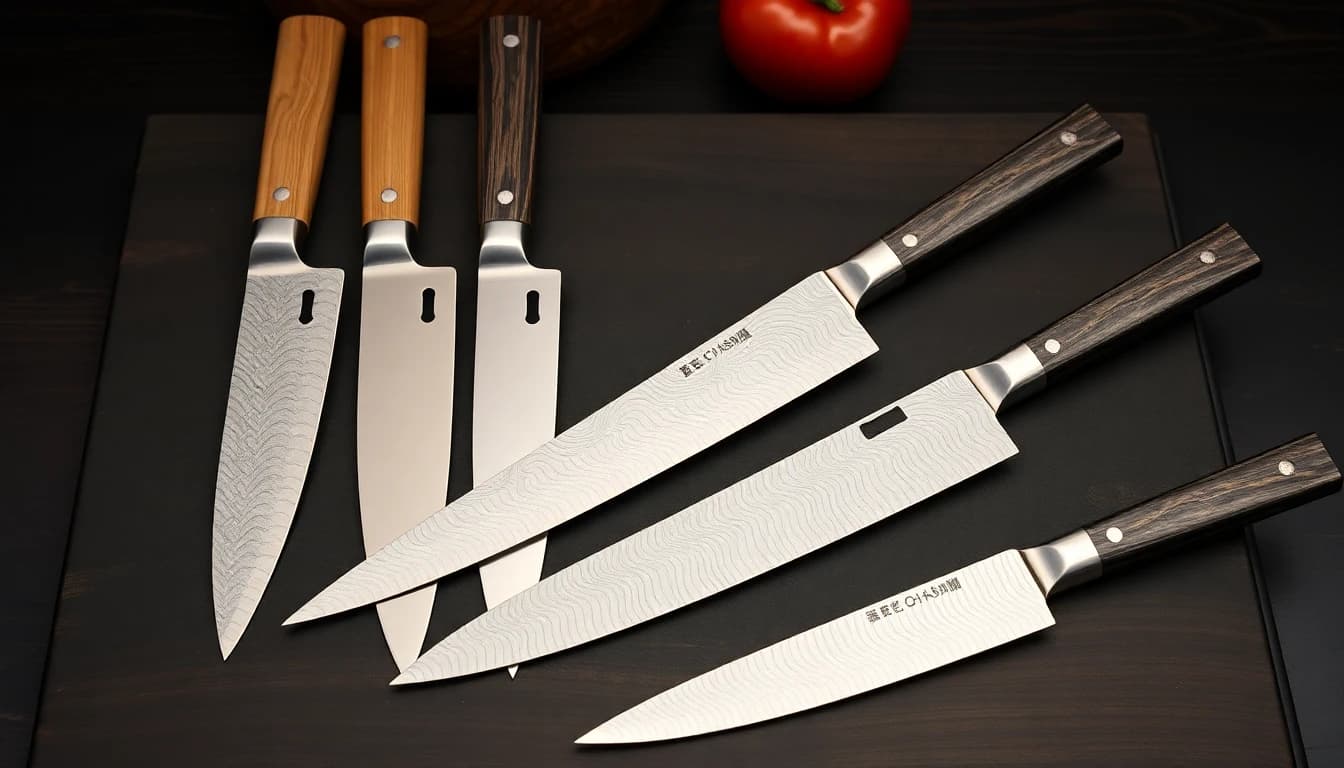
Damascus steel refers to the visible wave-like pattern created by folding and layering different steels together. In modern kitchen knives, Damascus typically forms the outer cladding around a harder core steel (often VG-10 or Aogami Super).
Does Damascus make a knife cut better? No. The core steel determines cutting performance. Damascus cladding adds corrosion resistance to the blade's flat and creates a striking visual effect. Think of it as functional art.
Damascus knives command a price premium. If your budget is limited, spend on better core steel rather than a Damascus pattern.
Hardness (HRC): What the Numbers Mean
The Rockwell Hardness Scale (HRC) measures how resistant a steel is to deformation. Higher HRC means the steel holds a sharper edge longer. But harder steel is also more brittle.
- HRC 54-58 (Western standard) — German X50CrMoV15. Tough, easy to maintain; edge dulls faster
- HRC 59-61 (Japanese entry) — VG-10, Shirogami #2. Sharper edge; moderate maintenance
- HRC 62-64 (Japanese mid-range) — Aogami #2, SG2/R2. Long-lasting edge; careful handling needed
- HRC 65-67 (Japanese premium) — ZDP-189, Aogami Super. Extreme edge retention; difficult to sharpen, chip-prone For most users, the 59 to 63 HRC range offers the best balance of performance and forgiveness.
Japan's Knife-Making Regions
Japan has four major centers of knife production. Each has a distinct history, specialty, and personality. Knowing where your knife comes from adds context to its character.
Seki (Gifu Prefecture): Volume Meets Quality
Seki's blade-making heritage dates to the Kamakura period (1185 to 1333), when swordsmith Motoshige settled in the area, drawn by the quality of local clay and charcoal. Master smith Kanemoto Magoroku later forged blades of legendary sharpness.
Today, Seki produces approximately 50% of all knives made in Japan, making it the largest production center by volume. The city stands alongside Solingen (Germany) and Sheffield (England) as one of the world's three great cutlery capitals. Major brands based in Seki include Kai (Shun), Mcusta, and Yaxell (Source: LeeKnives Regional Guide).
Seki knives tend to be stainless steel, factory-finished, and consistently high-quality. They are excellent value for money. If you want reliability without the premium of a handmade blade, start here.
Sakai (Osaka Prefecture): The Professional's Choice
Sakai's metalworking roots trace back 600 years to the production of tobacco-cutting knives during the Edo period. The shogunate granted Sakai a monopoly on these blades, establishing a reputation for sharpness that persists today.
Sakai produces over 90% of Japan's professional-grade hand-forged kitchen knives. What makes Sakai unique is the division of labor: forging, sharpening, and handle-fitting are each performed by different specialized artisans. A single knife passes through at least three pairs of hands before completion. This system produces extraordinary consistency at a high craft level (Source: LeeKnives Regional Guide).
Sakai knives are often single-bevel, carbon steel, and built for professionals. Brands and workshops to know: Sakai Takayuki, Sakai Ichimonji Mitsuhide, and Aoki Hamono.
Tsubame-Sanjo (Niigata Prefecture): Innovation Hub
Tsubame and Sanjo sit in Niigata's flat river plains, an area historically prone to flooding. When farming alone could not sustain the population, Edo-period officials brought in blacksmiths from the capital to teach nail-making. From those humble beginnings, the region evolved into Japan's metalworking heartland (Source: LeeKnives Regional Guide).
Today, Tsubame is known for precision metal polishing (their stainless steel exports include Apple product components), while Sanjo maintains a more traditional forging approach. The region's most famous knife brand is GLOBAL, which pioneered the one-piece stainless steel handle design in 1985. Other notable makers include Tadafusa, Tojiro, and Yoshikane.
Tsubame-Sanjo knives often feature innovative designs and modern stainless steels. The region bridges tradition and industrial engineering.
Takefu (Fukui Prefecture): The Steel Artisans
Takefu traces its blade-making lineage to the 14th century and the legendary swordsmith Chiyozuru Kuniyasu. Located in Fukui Prefecture along the Sea of Japan coast, the region is known for exceptionally high-quality steel work.
The defining institution here is the Takefu Knife Village, a collaborative workshop where 13 independent knife companies share facilities and resources. This cooperative model has been critical for survival, allowing small artisan workshops to pool investment in equipment while maintaining their individual creative identities.
Takefu knives are prized for their steel quality. The region has pioneered the use of proprietary steels and advanced heat treatment techniques that influence knife-making across Japan.
How to Choose Your First Japanese Knife
Choosing a knife is personal. But a few decision points will narrow the field quickly.
Budget Guide
Japanese knives span an enormous price range. Here is what each tier typically offers.
$50 to $100
- What to expect: Factory-made, good stainless steel (AUS-8 or Molybdenum Vanadium). Solid performers that outcut most Western knives at double the price.
- Recommended picks: Tojiro DP Gyuto (VG-10), Fujiwara FKM Gyuto, Mac Superior Santoku
$100 to $200
- What to expect: Higher-grade steel (VG-10 core, SG2), better fit and finish. Damascus cladding appears at this tier. You begin to see hand-sharpened edges.
- Recommended picks: Takamura R2 Gyuto, Tojiro Shippu (VG-10 Damascus), Mac Professional Gyuto
$200 to $400
- What to expect: Artisan-quality. Hand-forged blades, premium steels (Aogami, SG2, R2). Noticeable improvement in edge geometry and balance.
- Recommended picks: Masakage Yuki Gyuto (Aogami Super), Yoshikane Hamono, Takeshi Saji
$400+
- What to expect: Master-class. Renowned individual blacksmiths, custom handles, collectible status. Diminishing practical returns, but the craftsmanship is at art level.
- Recommended picks: Takeshi Saji R2 Damascus, Yoshimi Kato, custom Sakai commissions For a first purchase, the $100 to $200 range delivers the most dramatic improvement in your cooking experience per dollar spent.
Single Bevel vs Double Bevel
Double bevel (both sides sharpened) is the default for home cooks and most Western-trained chefs. It cuts straight, works in both hands, and is straightforward to sharpen.
Single bevel (one side ground flat, the other concave) is the traditional Japanese professional format. It creates asymmetric cuts that are cleaner on one side. Sashimi and vegetable cuts benefit from this precision. However, single-bevel knives pull to one side during cutting, require specific sharpening skills, and are made for either right- or left-handed users (not both).
If you are new to Japanese knives, start with double bevel. Graduate to single bevel once you are comfortable with whetstone sharpening.
Handle Types: Wa-Handle vs Western
The wa-handle (Japanese handle) is typically octagonal or D-shaped, made from lightweight woods like ho (magnolia) or burned chestnut. It shifts the knife's balance point forward toward the blade. This encourages a pinch grip and gives the sensation of the blade doing the work.
The Western handle is riveted, contoured, and heavier. It shifts balance toward the hand. Many people find it more immediately comfortable, especially if they have used Western knives their whole life.
Neither is objectively better. If possible, hold both before buying. The handle you forget about during cooking is the right one for you.
The "Desert Island" Recommendation
If you could only own one Japanese knife, buy a 210 mm Gyuto in VG-10 or SG2 steel with a wa-handle. Budget around $120 to $180. This combination handles 90% of kitchen tasks, is forgiving on maintenance, and teaches you the fundamentals of Japanese knife technique.
Add a 150 mm Petty as your second knife. Together, they cover nearly everything a home cook encounters.
Where to Buy Japanese Knives
Online: Reputable Retailers
The safest way to buy Japanese knives online is through specialist retailers with deep knowledge and direct relationships with makers.
- Korin (New York) — The gold standard for Japanese knives in the US. Professional-grade selection.
- Chubo Knives — Curated selection, excellent educational content.
- Japanese Knife Imports (JKI) — Jon Broida's shop in Los Angeles. Thoughtfully chosen lineup with video reviews.
- Cleancut (Sweden) — Europe's premier Japanese knife retailer.
- Knives and Stones (Australia) — Strong selection for Asia-Pacific buyers.
Avoid random Amazon listings that claim "Japanese steel" without specifying the exact steel type, maker, or production region.
In Japan: Knife District Walking Tours
Buying knives in person in Japan is an experience in itself. These are the destinations to prioritize.
Kappabashi Street, Tokyo: Tokyo's "Kitchen Town" has over a dozen knife shops within walking distance. Tsubaya and Kamata are excellent starting points. Staff at most shops speak some English and can help you choose based on hand size and cooking style.
Sakai, Osaka: Visit the Sakai Traditional Crafts Museum (Sakai Hamono Museum) for live sharpening demonstrations. Several workshops offer factory tours where you can watch forging, grinding, and handle-fitting. Sakai Ichimonji Mitsuhide has a retail shop attached to their workshop.
Seki, Gifu: The Seki Traditional Swordsmith Museum celebrates the region's 800-year heritage. The annual Seki Cutlery Festival (held every October) draws thousands of buyers with deep discounts directly from manufacturers.
For those interested in combining knife shopping with a broader journey through Japan's craft regions, explore our Travel section for curated itineraries that connect artisan workshops with wellness experiences.
Authenticating Your Purchase
Counterfeiting is a growing problem, especially online. Protect yourself with these checks:
- Kanji markings: Legitimate Japanese knives typically have the maker's name or brand etched or engraved in kanji on the blade. If a knife claims to be from Sakai but has no kanji, be skeptical.
- Steel specification: Reputable sellers list the exact steel type (e.g., VG-10, Aogami #2). Vague claims like "high-carbon Japanese steel" are a red flag.
- Price sanity check: A hand-forged Sakai knife cannot cost $30. If the price seems too good, it is.
- Buy from specialists: The retailers listed above stake their reputations on authenticity.
Care and Maintenance
A Japanese knife is an investment. Proper care ensures it performs for decades, not months.
🛑 Safety Notice
Sharpening with Whetstones
Whetstones (toishi) are the gold standard for sharpening Japanese knives. Electric sharpeners and pull-through devices remove too much material and cannot match the precision of a stone.
The basic setup: A combination stone with 1000 grit (medium) and 3000 to 6000 grit (fine) handles all regular maintenance. King, Shapton, and Suehiro are trusted brands. Budget $30 to $60 for a quality starter stone.
Angle: Most Japanese knives sharpen at 10 to 15 degrees per side. This is shallower than the 20-degree angle used for Western knives. Maintaining a consistent angle matters more than applying heavy pressure (Source: Hasu-Seizo Sharpening Guide).
Frequency: Sharpen on the 1000 grit stone every two to four weeks with regular home use. Follow with the fine stone to refine the edge. Between sharpenings, a ceramic honing rod gently realigns the edge without removing material.
Soaking: Medium stones need five to ten minutes of soaking before use. Finer stones (3000 grit and above) often work as splash-and-go: just wet the surface. Check the manufacturer's instructions.
Storage
Never toss a Japanese knife loose in a drawer. The thin edge will chip against other utensils. Recommended storage options:
- Magnetic knife strip: Wall-mounted, visible, and convenient. Use a wood-faced strip to avoid scratching the blade.
- Knife guard (saya): A wooden sheath that protects the blade individually. Many Japanese knives ship with one.
- In-drawer knife block: Horizontal slots keep blades separated.
Dos and Don'ts
Do:
- Hand wash immediately after use
- Dry completely before storing
- Use a wood or soft plastic cutting board
- Cut food only (no bones with a Gyuto)
- Sharpen on whetstones
- Learn the pinch grip for control
Don't:
- Put it in the dishwasher (heat warps handles, detergent dulls edges)
- Leave it wet in the sink (carbon steel rusts in minutes)
- Cut on glass, marble, ceramic, or metal surfaces
- Use it to pry, lever, or scrape sideways
- Use pull-through sharpeners or electric grinders
- Grip the handle like a hammer (less control, more fatigue) Carbon steel owners: embrace the patina. A dark, mottled blade is a sign of use, not neglect. The patina actually slows further oxidation. If orange rust appears, remove it immediately with a rust eraser (sabitori) or baking soda paste.
The Market Context: Why Now?The global knife market is valued at approximately $4.8 billion in 2025 and is projected to reach $8.5 billion by 2034, growing at a CAGR of 6.5% (Source: Fortune Business Insights). Japan contributes roughly 7% of this market but dominates the premium segment.
Japanese carbon steel knife exports grew 11.6% in 2023, driven by professional chef demand in North America and Europe. Seki City alone accounts for 46.3% of Asia-Pacific knife exports, with approximately 40% of its production destined for the United States (Source: Business Research Insights).
Meanwhile, there are over 60,000 Japanese restaurants across 185 countries (Source: Japan Ministry of Agriculture). Each one represents potential demand for authentic Japanese kitchen tools. The appetite for Japanese knives has never been stronger.
For those interested in how Japanese craftsmanship connects to broader market trends, our Craft articles cover everything from ceramics and textiles to lacquerware and beyond.
Frequently Asked Questions
What is the best Japanese knife for a beginner?
A 210 mm Gyuto in VG-10 steel is the most versatile starting point. It handles meat, fish, and vegetables equally well. Budget $100 to $180 for a quality entry-level blade from brands like Tojiro, Mac, or Takamura.
Are Japanese knives worth the price compared to German knives?
For precision cutting, yes. Japanese knives are harder, sharper, and lighter than most German alternatives. They require more careful handling and maintenance, but the cutting performance difference is immediately noticeable. A $120 Japanese Gyuto will outperform a $200 German chef knife in sharpness and edge retention.
Can I put a Japanese knife in the dishwasher?
No. Dishwasher heat can warp wooden handles, and the harsh detergent degrades the edge. Hand wash with warm water and mild soap immediately after use, then dry thoroughly. This takes 30 seconds and protects a knife that could last a lifetime.
How often should I sharpen my Japanese knife?
With regular home use, sharpen on a 1000 grit whetstone every two to four weeks. Between sharpenings, use a ceramic honing rod to maintain edge alignment. Professional chefs often sharpen daily or weekly depending on volume.
What is the difference between single bevel and double bevel?
Double bevel knives are sharpened symmetrically on both sides. They cut straight and work for both right- and left-handed users. Single bevel knives are sharpened on one side only, producing more precise cuts for techniques like sashimi slicing. Single bevel requires more skill to sharpen and use. Beginners should start with double bevel.
Do Japanese knives rust?
Carbon steel Japanese knives (Shirogami, Aogami) will rust if left wet. They develop a protective patina with use that slows further oxidation. Stainless steel knives (VG-10, SG2, ZDP-189) resist rust under normal conditions. Always dry any knife immediately after washing.
What is Damascus steel and does it make the knife better?
Damascus refers to the wavy pattern created by layering different steels. In modern kitchen knives, it is cosmetic cladding around a harder core steel. Damascus does not improve cutting performance, but it adds corrosion resistance to the blade flat and looks beautiful. Buy Damascus for aesthetics, not for a sharper edge.
Where in Japan should I buy knives?
Kappabashi Street in Tokyo has over a dozen knife shops and is the most accessible for visitors. Sakai (Osaka) is the heartland of professional knife-making with workshop tours available. Seki (Gifu) hosts an annual Cutlery Festival every October with discounts directly from manufacturers.
How do I know if a Japanese knife is authentic?
Look for kanji engravings on the blade identifying the maker. The seller should specify the exact steel type and production region. Avoid listings that use vague terms like "Japanese-style steel." Buy from specialist retailers rather than generic marketplaces.
What cutting board should I use with Japanese knives?
Use end-grain wood or soft rubber cutting boards. The Japanese professional standard is hinoki (cypress) wood. Avoid glass, marble, ceramic, and bamboo boards, which are too hard and will damage the thin edge of a Japanese blade.
Where to Go From Here
Japanese kitchen knives represent one of the most accessible entry points into Japan's centuries-old craft traditions. A single well-chosen blade transforms your daily cooking and connects you to a lineage of makers who have refined their art across generations.
If this guide has sparked your interest, here are your next steps:
- Explore our full Craft collection for more stories of Japanese artisans and their work
- Read our Wellness content to discover how mindful cooking connects to broader well-being practices
- Plan a trip to Japan's knife-making regions through our Travel guides
- Subscribe to our newsletter for new articles on Japanese craftsmanship, delivered weekly
Have questions about sourcing Japanese knives for your restaurant, retail shop, or personal collection? Get in touch with the Scratch Second team.
Written by Hiro Miyamoto
Founder & CEO of Scratch Second. Starting from corporate sales at a South American food supplier, Hiro went on to spearhead the Japan market launch as VP of Sales at a Silicon Valley foodtech company — placing products in 2,400+ convenience stores and supplying ingredients for an international expo. He currently leads business development across Asia at one of the world's largest tech companies. Off the clock, he's a dedicated yachtsman, yogi, and sauna enthusiast who writes about the intersection of modern healthtech and Japan's timeless wellness traditions.
Related Articles
craft
Wajima Lacquerware: Why Japan's Most Resilient Craft Deserves Your Attention
A complete guide to Wajima-nuri lacquerware — the 124-step process, how it compares to other Japanese lacquer, what to buy, where to buy, and how Wajima is r...
craft
Japan's Matcha Exports Surpass 10,000 Tons for the First Time in 71 Years
In 2025, Japanese tea exports exceeded 10,000 tons for the first time since 1954. Behind the matcha boom lies a deepening supply shortage, soaring prices, and a structural shift in Japan's tea farming industry.
craft
Why HOSOO Moves the World — A 327-Year-Old Nishijin Weaver's Path to Dior and Chanel
How HOSOO, a 327-year-old Nishijin-ori weaving house in Kyoto, became the textile supplier to Dior, Chanel, and Hermes. An in-depth look at their 150cm-wide loom innovation, LVMH partnership, and Milan expansion.