
craft · 11min read · 2026-02-21
Japanese Bamboo Craft: The Complete Guide to Takezaiku
Explore takezaiku, Japan's bamboo craft tradition. History, regional styles from Beppu to Suruga, weaving techniques, Living National Treasures, and buying guide.
Key Takeaways
- Takezaiku encompasses over 600 bamboo species used in Japanese craft
- Beppu and Suruga are the two major bamboo craft production centers
- Museum-quality bamboo sculptures sell for $10,000 to $100,000 at auction
- The Met acquired 252 bamboo works in 2017, elevating global recognition
- Madake, hachiku, and susudake are the three primary bamboo species used
What Is Takezaiku? Japan's Bamboo Craft Tradition
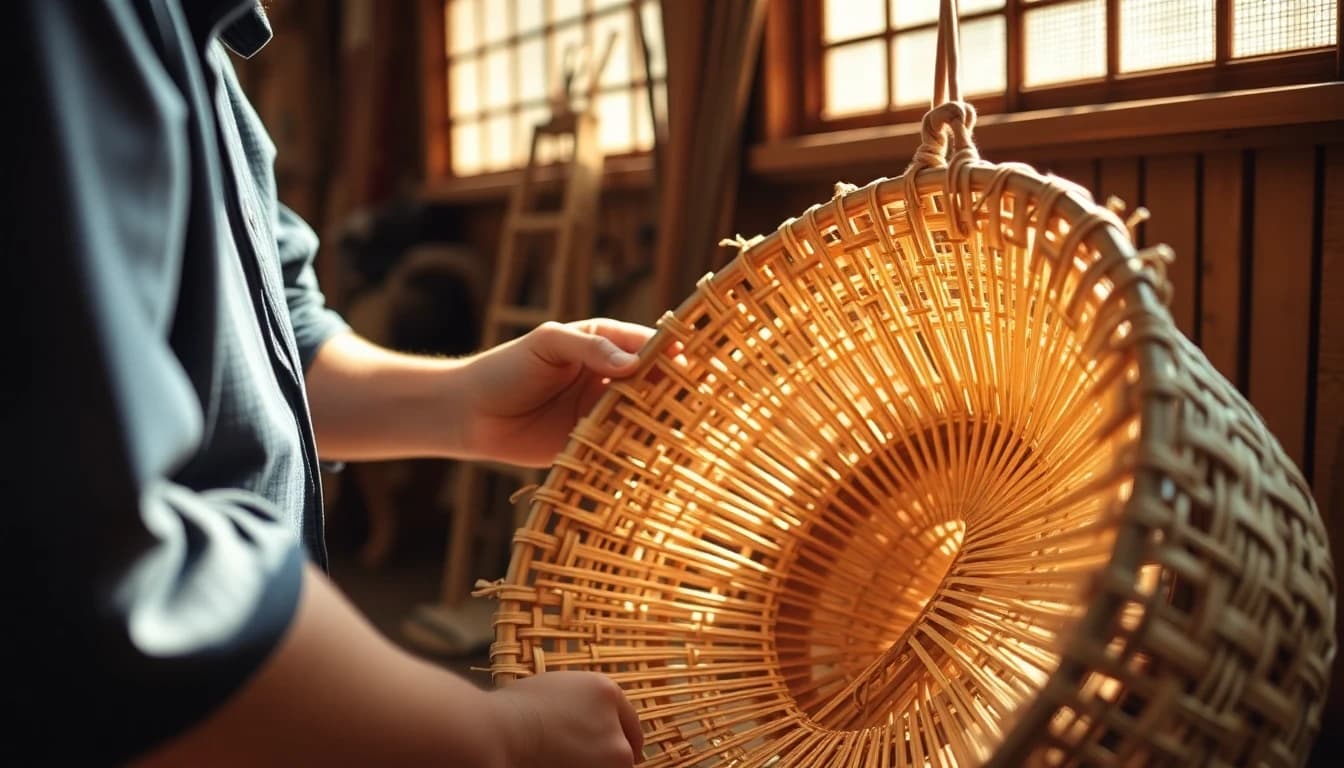
A single culm of madake bamboo, split by hand into strips thinner than a matchstick, bent and woven into a basket that will outlast the artisan who made it. This is takezaiku -- Japanese bamboo craft -- and it represents one of the most technically demanding and visually arresting craft traditions in the world.
Japan is home to over 600 species of bamboo, and the relationship between the Japanese people and this grass-turned-timber stretches back to the earliest recorded mythology (Source: Highlighting Japan, Government of Japan). The Tale of the Bamboo Cutter, considered Japan's oldest narrative, tells the story of a luminous princess found inside a bamboo stalk. From the beginning, bamboo in Japan has been both material and metaphor -- strength, flexibility, renewal, and grace.
Yet bamboo craft in Japan faces a paradox. Global collectors now pay tens of thousands of dollars for museum-quality bamboo sculptures at Christie's and Sotheby's. Meanwhile, the number of working bamboo artisans in Japan continues to decline, with fewer young apprentices entering the field each decade. What was once an everyday material -- baskets, fences, utensils, architecture -- has become an endangered art form.
What struck me first when visiting bamboo workshops in Beppu was the sound. Not silence, but a rhythmic percussion: the tap of a splitting knife, the whisper of a strip being drawn through fingers, the gentle creak of bamboo bending under controlled pressure. Every workshop had its own tempo.
A Brief History of Japanese Bamboo Craft
Bamboo has been used in Japan since the Jomon period (14,000-300 BCE), but its transformation from utilitarian material to recognized art form is a story of slow elevation across centuries.
The pivotal shift occurred in the early 20th century. Before that, bamboo craft was functional -- baskets for rice storage, trays for drying food, containers for transport. The founding of Beppu's bamboo technical school in 1902 began professionalizing the craft (Source: Enjoy Onsen, Beppu). By mid-century, artists like Shono Shounsai were creating abstract bamboo sculptures that owed as much to modernist aesthetics as to traditional basket-making.
The 2017 acquisition of the Abbey Collection by the Metropolitan Museum of Art marked a watershed moment. Suddenly, Japanese bamboo art occupied the same institutional space as Edo-period paintings and Momoyama-era ceramics (Source: The Culture Concept Circle). Auction prices followed. Pieces by recognized masters now regularly sell for $10,000 to $100,000 at international auctions.
Bamboo Species Used in Japanese Craft
Not all bamboo is created equal. Japanese artisans select species with the precision of a woodworker choosing between oak and walnut. The three primary species form the backbone of takezaiku.
Madake (Phyllostachys bambusoides)
The king of Japanese craft bamboo. Madake is believed to be native to Japan since prehistoric times, and its name literally means "true bamboo" (Source: Highlighting Japan, Government of Japan). It grows up to 20 meters tall with culms reaching 10-15 centimeters in diameter.
- Key traits: Dense fiber structure, even grain, splits cleanly along the length
- Best for: Baskets, flower vases, tea utensils, fine weaving
- Where it grows: Throughout southern Honshu, Shikoku, and Kyushu
- Why artisans prefer it: The outer skin is smooth and hair-free, making it ideal for items that contact food or skin
Mosochiku (Phyllostachys edulis)
The largest bamboo species in Japan, introduced from China approximately 500 years ago. Moso bamboo dominates Japan's bamboo forests, accounting for an estimated 70% of total bamboo acreage.
- Key traits: Thick walls, large diameter (up to 18 cm), rapid growth
- Best for: Furniture, architectural elements, large containers, bamboo charcoal
- Where it grows: Nationwide, especially Kyushu and Shikoku
- Why it matters: Its abundance makes it the most commercially available species, though artisans consider it less refined than madake for fine work
Hachiku (Phyllostachys nigra var. henonis)
The artisan's bamboo for delicate work. Hachiku is thinner and more flexible than madake, with a pale, almost white color when dried.
- Key traits: Slender culms, exceptional flexibility, fine grain
- Best for: Tea whisks (chasen), lantern frames, musical instruments, fine basketry
- Where it grows: Native to Japan, found throughout temperate regions
- Special note: The chasen (bamboo tea whisk) used in every matcha ceremony is carved from a single piece of hachiku by fewer than two dozen remaining artisans in Takayama, Nara Prefecture
Regional Specialties: Japan's Bamboo Craft Centers
Japanese bamboo craft is not monolithic. Each region developed distinct techniques, aesthetics, and specializations shaped by local bamboo species, climate, and cultural demand.
Beppu (Oita Prefecture) -- The Capital of Bamboo Weaving
Beppu is to bamboo craft what Seki is to kitchen knives: the undisputed center. The city's bamboo tradition is said to originate from when the 12th Emperor of Japan visited Beppu and his chef wove a rice bowl basket from local bamboo (Source: KOGEI JAPAN).
By the Muromachi period (1336-1573), bamboo baskets were used by nomadic peddlers to carry merchandise. During the Edo period, as Beppu became one of Japan's most popular hot spring destinations, bamboo souvenirs became a local industry.
What makes Beppu unique:
- Eight fundamental weaving patterns: Cross, hexagonal, octagonal, netting, mat, pine needle, chrysanthemum bottom, and bull's eye
- Over 200 pattern combinations: These eight base patterns can be combined into more than 200 distinct weaves
- Full production chain: From bamboo harvesting to finished product, everything happens within the region
- Designated Traditional Craft: Officially recognized by METI in 1979
- Educational infrastructure: The Oita Prefectural Bamboo Craft Training Center continues to train new artisans
What to buy in Beppu: Woven baskets ($30-300), colanders and strainers ($20-80), flower baskets ($50-500), decorative wall pieces ($100-2,000+)
Where to visit: The Beppu City Traditional Bamboo Crafts Center houses over 2,000 bamboo works spanning historical and contemporary pieces, and admission is free (Source: JNTO).
Suruga (Shizuoka Prefecture) -- The Art of a Thousand Lines
Suruga bamboo ware (Suruga takesensuji zaiku) is instantly recognizable by its almost impossibly fine strips. The name "sensuji" means "a thousand lines," referring to the fact that a thousand bamboo strips can be laid side by side across a single 90-centimeter tatami mat (Source: KOGEI JAPAN).
This craft originated in the Edo period when Tokugawa Ieyasu, who established his retirement castle in Shizuoka, commissioned bamboo artisans to create refined objects for falconry and court life. The strips had to be so smooth and fine that they would not damage the delicate feathers of hunting birds.
What makes Suruga unique:
- Strip width: As thin as 0.8 mm in diameter -- thinner than a toothpick
- Round cross-section: Unlike the flat strips used in Beppu weaving, Suruga strips are round, creating a distinctive three-dimensional texture
- Geometric precision: Patterns rely on mathematical regularity rather than organic flow
- Designated Traditional Craft: Officially recognized by METI in 1976
What to buy in Suruga: Insect cages ($30-100), vases ($40-200), lampshades ($60-300), decorative boxes ($50-250)
Kyoto -- Tea Ceremony Bamboo
Kyoto's bamboo craft tradition is inseparable from the tea ceremony. Rather than producing baskets for daily use, Kyoto artisans have historically focused on the refined bamboo objects required for chado: flower baskets (hanakago), water ladles (hishaku), tea scoops (chashaku), and fence-style room dividers.
What makes Kyoto unique:
- Tea master lineage: Designs often follow specifications set by historical tea masters
- Smoked bamboo (susudake): Bamboo darkened by decades of exposure to hearth smoke in thatched-roof farmhouses is prized for its deep amber color and aged character
- Collaboration with other crafts: Kyoto bamboo artisans frequently work with lacquer artists, metalworkers, and textile dyers to create composite objects
What to buy in Kyoto: Tea scoops ($15-100), flower baskets ($80-1,000+), bamboo chopsticks ($8-20), hand fans ($15-40)
Other Notable Regions
- Hinokage (Miyazaki Prefecture): Known for kagobuta, bamboo lids woven so tightly they are waterproof
- Taketa (Oita Prefecture): Famous for the Taketa Bamboo Lantern Festival, where 20,000 bamboo lanterns illuminate the castle town each November
- Nara Prefecture (Takayama): The exclusive center of chasen (tea whisk) production
Production Techniques: From Culm to Craft
Understanding how bamboo is transformed from a raw culm into a finished object deepens appreciation for the craft. Every piece of takezaiku passes through several distinct stages.
1. Harvesting and Seasoning
Bamboo is typically harvested in autumn or winter, when sap content is lowest and the culm is densest. Freshly cut bamboo contains up to 80% moisture and must be seasoned -- either air-dried for several months or kiln-dried -- before it can be worked. Improperly seasoned bamboo will crack, warp, or attract insects.
2. Splitting (Hedawari)
This is where the artisan's skill first becomes visible. Using a specialized splitting knife (nata), the craftsperson divides a single culm into progressively thinner strips. A skilled splitter can produce strips of uniform width and thickness from a single culm in minutes. The process requires reading the bamboo's grain, feeling for irregularities, and adjusting pressure in real time. In Beppu, artisans say that splitting accounts for 80% of the final product's quality.
3. Shaving and Finishing Strips (Higo-tsukuri)
After splitting, each strip must be shaved to its final dimensions. For Beppu weaving, strips are typically flat and thin. For Suruga work, strips are scraped into round cross-sections. The artisan draws each strip through a series of planes and gauges, removing material until the strip is perfectly uniform. In Suruga, this process produces strips as fine as 0.8 mm in diameter.
4. Bending and Shaping
Bamboo is bent using heat -- either a charcoal flame or an electric heating element. The artisan heats a specific point on the strip until the lignin softens, then bends it to the desired angle and holds it until it cools. Complex forms like ribbed baskets require dozens of individually heated and shaped ribs, each matching a template.
5. Weaving (Ami)
The heart of Beppu bamboo craft. Weaving patterns range from simple cross-weave (yotsume-ami) suitable for a beginner's first basket to hexagonal weave (mutsume-ami) and the demanding chrysanthemum base (kikuzoko-ami) that requires 32 or more strips radiating from a central point.
6. Finishing
Finished pieces may be left in their natural state, lacquered for water resistance, or treated with persimmon tannin (kakishibu) for a warm brown patina. Some artisans apply urushi lacquer -- the same material used in Japanese lacquerware -- for both protection and aesthetic contrast between the dark lacquer and exposed bamboo grain.
Living National Treasures: Masters of Bamboo Art
Japan's Living National Treasure (Ningen Kokuho) designation recognizes individuals who have achieved the highest level of mastery in traditional arts. Six bamboo artists have received this honor, elevating bamboo from craft to nationally recognized fine art (Source: Japan Kogei Association).
Shono Shounsai (1904-1974) -- The Pioneer
Designated in 1967 as the first Living National Treasure for bamboo art. Shounsai transformed the field. Before him, bamboo baskets were functional objects or flower containers for ikebana. After him, bamboo became sculpture (Source: Artsy).
His post-war works abandoned traditional basket forms entirely, creating abstract sculptural pieces that explored the material's inherent tension between rigidity and flexibility. His pieces now reside in the collections of the Metropolitan Museum of Art, the Victoria and Albert Museum, and the Museum of Fine Arts, Boston.
Iizuka Shokansai (1919-2004) -- Precision and Innovation
Designated in 1982. The Iizuka family dominated bamboo art in eastern Japan for three generations. Shokansai inherited techniques from his father Rokansai and grandfather Hosai, then pushed them further. He was renowned for combining traditional weaving with unexpected forms -- creating bamboo vessels that referenced modernist ceramics and industrial design.
Fujinuma Noboru (1945-) -- The Contemporary Master
Designated in 2012. Fujinuma studied under Living National Treasure Iizuka Shokansai and is known for monumental bamboo sculptures that blur the line between craft object and contemporary art. His works have been exhibited at the Smithsonian Institution and the Philadelphia Museum of Art.
Broader Impact
The Living National Treasure system has done more than honor individuals. It has created an institutional framework for preserving bamboo techniques. Designated masters receive government support and are expected to train successors, ensuring that specific weaving patterns, splitting techniques, and finishing methods survive into the next generation.
Types of Bamboo Craft Objects
Bamboo craft in Japan encompasses a vast range of functional and decorative objects. Here are the major categories.
Baskets (Kago)
The foundational form. Japanese bamboo baskets range from simple agricultural containers to museum-quality art objects. Categories include:
- Hanakago (flower baskets): The most collected form. Used in tea ceremony and ikebana. Prices range from $50 for a production piece to $50,000+ for work by a recognized master
- Meshikago (rice baskets): Beppu's original souvenir item, originally used for storing cooked rice
- Buying baskets (kaimono kago): Everyday market baskets experiencing a sustainability-driven revival
Flower Vases (Hanaire)
Bamboo flower vases for tea ceremony use are among the most highly valued bamboo objects. The most prized are made from susudake (smoke-darkened bamboo) that has spent decades in the rafters of a traditional farmhouse. A single susudake vase from a recognized maker can sell for $1,000-10,000.
Tea Utensils
- Chasen (tea whisk): Carved from a single piece of hachiku. Essential for preparing matcha. Read more in our guide to Japanese tea and matcha
- Chashaku (tea scoop): A slender, curved spoon for measuring matcha powder
- Hishaku (water ladle): Used to transfer water in the tea ceremony
Furniture and Architectural Elements
- Sudare (bamboo blinds): Rolled bamboo screens used in traditional architecture for shade and ventilation
- Takeho (bamboo fences): Particularly associated with Kyoto garden design
- Bamboo shelving and lighting: Contemporary designers are creating modern furniture that honors traditional techniques
Sculpture
The newest category, emerging in the mid-20th century through the work of Shono Shounsai and his contemporaries. Bamboo sculpture is now a recognized category at international art fairs and museums. The Metropolitan Museum of Art holds over 250 bamboo art objects in its permanent collection.
The Modern Revival: Bamboo Craft Today
Japanese bamboo craft stands at a crossroads. On one side, aging artisans and declining apprenticeship numbers. On the other, growing international recognition, rising auction prices, and a sustainability narrative that positions bamboo as one of the world's most renewable materials.
Challenges
- Aging workforce: The average age of bamboo artisans in Beppu exceeds 60. Few young people enter the multi-year apprenticeship required to master splitting and weaving
- Cheap imports: Mass-produced bamboo goods from Southeast Asia undercut prices for everyday items, removing the economic base that supported artisan communities
- Abandoned bamboo forests: Japan's bamboo forests are expanding uncontrolled as fewer people harvest bamboo, creating an ecological problem. An estimated 40,000 hectares of bamboo forest in Japan are classified as abandoned (Source: Nippon.com)
Revival Forces
- International art market: Japanese bamboo art has entered the contemporary art market. Auction results at Christie's, Sotheby's, and Bonhams have risen steadily since 2010
- Sustainability narrative: Bamboo grows to harvestable size in 3-5 years, sequesters carbon, and requires no pesticides. As consumers seek alternatives to plastic, bamboo's environmental profile drives new demand
- Design collaborations: Young Japanese designers are partnering with traditional artisans to create contemporary products -- lighting, furniture, fashion accessories -- that use traditional techniques in modern forms
- Women artisans: Historically male-dominated, the bamboo craft world is seeing its first generation of recognized women artists (Source: Studio International)
- Tourism workshops: Beppu and other bamboo centers now offer hands-on workshops for visitors, creating both income and awareness
Buying Guide: How to Choose Japanese Bamboo Craft
Purchasing bamboo craft requires understanding what separates a $30 tourist souvenir from a $3,000 collector's piece. Here are the key factors.
Material Quality
- Species: Madake commands the highest prices for woven work. Moso is acceptable for larger, structural pieces
- Grain: Look for tight, even grain with no discoloration or insect damage
- Age of bamboo: Three-to-five-year-old bamboo is considered ideal. Younger bamboo is too soft. Older bamboo becomes brittle
- Susudake premium: Smoke-darkened bamboo (susudake) commands a significant premium due to its rarity and aged character
Craftsmanship Indicators
- Strip uniformity: In high-quality work, every strip is the same width and thickness. Hold the piece up to light -- gaps between strips should be consistent
- Edge finish: Run your finger along cut edges. Quality work has smooth, slightly rounded edges with no splinters
- Base construction: The base of a basket reveals the most about the maker's skill. Complex base patterns (especially chrysanthemum and radiating designs) indicate advanced technique
- Binding: Where strips are tied together, look for tight, clean wrapping using rattan (tou) or thin bamboo strips
Price Ranges (USD)
- Tourist souvenirs: $10-50. Machine-assisted, often imported
- Artisan daily ware: $50-300. Handmade by trained craftspeople for everyday use
- Art craft: $300-3,000. Pieces by recognized artisans, often exhibited before sale
- Museum quality: $3,000-100,000+. Works by Living National Treasures, their direct students, or contemporary artists with gallery representation
Where to Buy
- Beppu City Traditional Bamboo Crafts Center: The most comprehensive selection under one roof. Prices are fair and quality is vetted
- Gallery Japan (online): The Japan Kogei Association's official online gallery, featuring vetted artisan work
- Department stores: Takashimaya, Mitsukoshi, and Isetan host regular craft exhibitions (kogei-ten) featuring bamboo artists
- Direct from workshops: If you visit Beppu or other production areas, buying directly from workshops often offers the best prices and the opportunity to see the work being made
- Auction houses: For museum-quality pieces, Christie's, Sotheby's, and Bonhams hold regular Japanese art auctions
Care and Maintenance
Bamboo is durable but requires basic care to maintain its beauty across decades.
- Keep dry: Wipe with a dry or slightly damp cloth. Never soak or submerge woven bamboo
- Avoid direct sunlight: Prolonged UV exposure bleaches the bamboo and weakens the fibers
- Oil occasionally: A light application of camellia oil (tsubaki abura) once or twice a year keeps the bamboo supple and enhances its natural sheen
- Store properly: Avoid extreme temperature changes. In dry climates, occasional light misting prevents cracking
Bamboo Craft and Japanese Culture
Bamboo is woven into Japanese culture as deeply as it is woven into baskets. The plant appears in the earliest myths, the most sacred rituals, and the most mundane daily routines.
- New Year (Kadomatsu): Bamboo is one of the three plants (with pine and plum) used in kadomatsu decorations placed at doorways to welcome ancestral spirits
- Seven Grasses of Autumn: Bamboo grass (sasa) is one of the seven plants celebrated in autumn poetry
- Tanabata Festival: Wishes are written on paper strips and hung from bamboo branches during the July star festival
- Architecture: From the bamboo fences of Kyoto temples to the bamboo ceilings of tearooms, the material defines Japanese interior space
This cultural depth is what separates Japanese bamboo craft from bamboo products made elsewhere. A Beppu basket is not just a container. It carries centuries of cultural meaning in every woven strip.
For those interested in other Japanese craft traditions with similar cultural depth, explore our guides to Japanese washi paper and Japanese pottery.
Visiting Bamboo Craft Centers in Japan
Beppu, Oita Prefecture
- Beppu City Traditional Bamboo Crafts Center: Free admission. Over 2,000 works on display. Gift shop with artisan pieces
- Workshop experiences: Several workshops offer 60-90 minute basket-weaving sessions (from approximately $20-40)
- Best combined with: Beppu's famous hot springs. The city has over 2,000 hot spring sources -- the highest density in Japan
- Access: 2 hours from Fukuoka by limited express train, or direct flights to Oita Airport
Shizuoka (Suruga)
- Suruga bamboo craft workshops: Several studios in central Shizuoka offer demonstrations and workshops
- Best combined with: Mount Fuji views, green tea plantations in the Makinohara Plateau
- Access: 1 hour from Tokyo by Shinkansen
Kyoto
- Arashiyama bamboo grove: The famous bamboo grove is a starting point. Continue north into Sagano for actual workshops
- Bamboo craft workshops: Several studios north of the grove offer bamboo lantern-making and basket-weaving sessions (Source: Kyoto Artisan Walks Guide)
- Best combined with: Tea ceremony experiences, Japanese incense shops in the Higashiyama district
- Access: Central Kyoto, easily reached from Tokyo (2 hours 15 minutes by Shinkansen)
Frequently Asked Questions
Bamboo bends but does not break. In this resilience lies the metaphor that has sustained Japanese bamboo craft for centuries -- an art form that adapts to each era while preserving the essential techniques that define it. Whether you are drawn to a simple kitchen colander or a museum-worthy sculptural basket, every piece of takezaiku connects you to one of Japan's most ancient and enduring material traditions.
Written by Hiro Miyamoto
Founder & CEO of Scratch Second. Starting from corporate sales at a South American food supplier, Hiro went on to spearhead the Japan market launch as VP of Sales at a Silicon Valley foodtech company — placing products in 2,400+ convenience stores and supplying ingredients for an international expo. He currently leads business development across Asia at one of the world's largest tech companies. Off the clock, he's a dedicated yachtsman, yogi, and sauna enthusiast who writes about the intersection of modern healthtech and Japan's timeless wellness traditions.
Related Articles
craft
Wajima Lacquerware: Why Japan's Most Resilient Craft Deserves Your Attention
A complete guide to Wajima-nuri lacquerware — the 124-step process, how it compares to other Japanese lacquer, what to buy, where to buy, and how Wajima is r...
craft
Japan's Matcha Exports Surpass 10,000 Tons for the First Time in 71 Years
In 2025, Japanese tea exports exceeded 10,000 tons for the first time since 1954. Behind the matcha boom lies a deepening supply shortage, soaring prices, and a structural shift in Japan's tea farming industry.
craft
Why HOSOO Moves the World — A 327-Year-Old Nishijin Weaver's Path to Dior and Chanel
How HOSOO, a 327-year-old Nishijin-ori weaving house in Kyoto, became the textile supplier to Dior, Chanel, and Hermes. An in-depth look at their 150cm-wide loom innovation, LVMH partnership, and Milan expansion.