
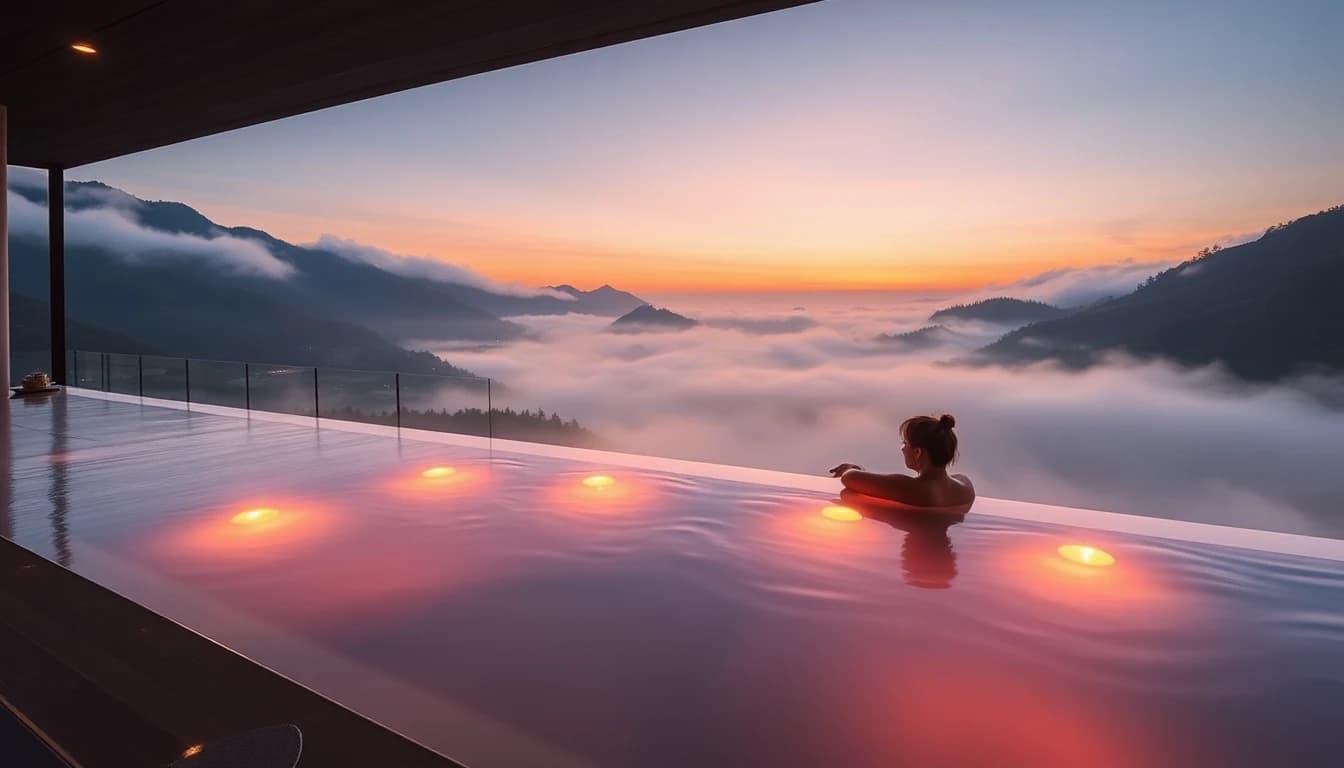
travel · 15min read · 2026-04-04
Longevity Retreats in Japan: The Complete Guide to Biohacking Meets Onsen
The definitive guide to longevity retreats in Japan. Biohacking facilities, onsen culture, facility comparisons, costs, and preparation — everything you need to plan a data-driven wellness stay.
Key Takeaways
- Longevity retreats combine biomarker testing with traditional onsen culture
- Japan is the world's longest-lived country at 84.3 years average life expectancy
- Programs include blood panels, genetic testing, HRV monitoring, and personalized protocols
- Okinawa is one of five global Blue Zones recognized for exceptional longevity
- Japan has approximately 27,000 natural hot spring sources nationwide
On the eighth floor of a Ginza building, Ayurvedic oil is being poured slowly across a forehead. On the fifth floor of the same building, a regenerative medicine IV drip falls silently. And through the window, the old Tsukiji fish market site stretches into the distance.
This is where "longevity retreats" stand in 2026. The steam of an onsen and the chill of a cryotherapy chamber now belong to the same conversation — and Japan is where that conversation is happening.
This guide maps the full landscape of Japan's emerging "longevity retreat" model, where centuries-old hot spring culture and cutting-edge biohacking converge. Facility comparisons, cost breakdowns, and step-by-step preparation — everything you need to make an informed decision, in a single article.
Who this guide is for: Wellness tourists, longevity practitioners, and affluent travelers seeking the most advanced health experiences in Japan. This is not a conventional onsen vacation guide — it is designed for those pursuing data-driven health optimization through an intentional, structured stay.
What Is a Longevity Retreat?
How It Differs from a Wellness Retreat
Let us define terms clearly.
- Wellness retreat: Primarily focused on relaxation and stress relief. Hot springs, yoga, meditation
- Longevity retreat: Primarily focused on extending healthspan. Biomarker testing, personalized programming, science-backed interventions
The difference comes down to this: does the experience end with how you feel, or does it begin with what your data says?
At a longevity retreat, blood panels and genetic testing are conducted before arrival, and a program is tailored to your individual biology. During the stay, HRV (heart rate variability), blood glucose, and sleep scores are continuously monitored. Post-stay follow-up completes the cycle.
Why Japan, and Why Now?
The case for Japan as the optimal longevity retreat destination is straightforward.
- The world's longest-lived country: Average life expectancy 84.3 years (Source: WHO, 2024)
- Blue Zone: Okinawa is one of the five global Blue Zones of longevity (Source: Blue Zones, Dan Buettner)
- Onsen resources: Approximately 27,000 natural hot spring sources nationwide (Source: Ministry of the Environment, Japan, 2023)
- Medical infrastructure: World-class research in regenerative medicine and preventive care
- Food culture: Fermented foods and washoku (traditional Japanese cuisine) are globally recognized as longevity diets
Japan's wellness tourism market reached approximately $59.3 billion in 2024 and is projected to grow to approximately $97.5 billion by 2033 (Source: IMARC Group, 2024). At the center of this growth: high-value tourism built around the "longevity" theme.
Connection to the Global Trend
Internationally, Fountain Life (USA, co-founded by Peter Diamandis) has set the standard for affluent longevity clinics with AI-powered full-body scans and preventive medicine programs. Annual membership runs approximately $19,500 (Source: Fountain Life official website).
This wave is reaching Japan. In October 2024, THE HUNDRED Longevity House opened in Ginza — a multi-floor complex offering regenerative medicine, Ayurveda, and fermented cuisine under one roof. A uniquely Japanese combination proposing "health for the 100-year life."
Three Types of Longevity Retreats in Japan
Longevity retreats available in Japan fall into three broad categories.
Type 1: Urban Clinic-Integrated Facilities
Characteristics: Located in central Tokyo or Osaka. Medical facilities on-site, offering regenerative medicine, diagnostics, and integrative therapies as an integrated package.
Key facilities:
- THE HUNDRED Longevity House (Ginza): A multi-floor complex (floors 5-9) combining a regenerative medicine clinic, Ayurveda salon, and fermented cuisine restaurant (Source: THE HUNDRED official website)
- CRYO TOKYO (Azabu-Juban): Specializing in cryotherapy (whole-body cold therapy), light sauna, and body sculpting (Source: CRYO TOKYO official website)
Best for: Those on short stays who want efficient access to cutting-edge technology. Business travelers looking to add a longevity session to their trip.
Type 2: Resort-Style Integrated Wellness Facilities
Characteristics: Set in natural environments, blending onsen, traditional Japanese culture, and structured wellness programs.
Key facilities:
- Amanemu (Ise-Shima, Mie Prefecture): 24 suites, all with private onsen. Herbal baths, acupuncture, kampo (traditional herbal medicine), and macrobiotic dining in a personalized immersion program (Source: Aman official website)
- Hoshinoya Okinawa: Located in Asia's only Blue Zone, offering a "Blue Zone Stay" program. Ryukyu karate, local antioxidant cuisine, and coastal activities (Source: Hoshino Resorts official website)
Best for: Travelers with five or more days available who want to reset deeply in a natural setting.
Type 3: Onsen x Biohacking Hybrid Facilities
Characteristics: Traditional toji (hot spring healing) culture integrated with modern biohacking equipment. A distinctly Japanese category.
Typical combinations:
- Onsen bathing + cryotherapy (a scientific evolution of traditional hot-cold contrast bathing)
- Shinrin-yoku (forest bathing) + HRV monitoring
- Fermented food dining + gut microbiome testing
- Zazen meditation + neurofeedback
Note: As of April 2026, fully integrated onsen-biohacking facilities in Japan are still in their early stages. The practical approach is to combine individual facilities into a custom program. This guide covers how to do exactly that.
Facility Comparison
| Facility | Location | Key Features | Stay Duration | Cost Estimate | Language |
|---|---|---|---|---|---|
| THE HUNDRED Longevity House | Ginza, Tokyo | Regenerative medicine + Ayurveda + fermented cuisine | Day visit and up | $290-440 per session (44,000-66,000 yen) | Japanese (primary) |
| Amanemu | Ise-Shima, Mie | Onsen + kampo + personalized program | 3-7 nights recommended | $1,000-3,300/night (150,000-500,000 yen) | English & Japanese |
| Hoshinoya Okinawa | Yomitan, Okinawa | Blue Zone stay + Ryukyu culture | 3 nights and up | $470-1,000/night (70,000-150,000 yen) | English & Japanese |
| CRYO TOKYO | Azabu-Juban, Tokyo | Cryotherapy + light sauna + body care | Single session | $65-330/session (10,000-50,000 yen) | English & Japanese |
| Hololife Center Japan | Tokyo | Biohacking products + events + community | Event attendance | Varies by event | English & Japanese |
Cost note: All prices above are estimates as of April 2026 and may vary depending on program selection, season, and exchange rates. Always confirm current pricing on official websites.
The Science Behind Biohacking + Onsen
This is the core of the article. Here is why combining biohacking with onsen bathing makes scientific sense.
The Science of Contrast Bathing
The most natural intersection of onsen culture and biohacking is contrast bathing — alternating between hot and cold exposure.
- Onsen bathing (38-42C / 100-108F): Vasodilation, muscle relaxation, parasympathetic nervous system activation (Source: Journal of Japanese Society of Balneology, 2023)
- Cold plunge / cryotherapy (-110C to 10C / -166F to 50F): Potential norepinephrine release, reduction in inflammatory markers reported (Source: European Journal of Applied Physiology, 2017)
- Alternating the two: Expansion of autonomic nervous system "bandwidth," with suggested improvements in resilience
Japan's traditional sauna, cold plunge, outdoor rest cycle is the prototype for this exact practice. Cryotherapy is best understood as a scientifically precise, temperature-controlled evolution of a ritual Japan has practiced for generations.
Red Light Therapy and Onsen Synergy
Red light therapy (also known as PBM: Photobiomodulation) uses light at 650-850nm wavelengths to stimulate mitochondrial activity.
- Promotion of collagen synthesis has been reported (Source: Photomedicine and Laser Surgery, 2014)
- Research on inflammation reduction is ongoing (Source: Lasers in Medical Science, 2017)
The hypothesis: performing red light therapy immediately after onsen bathing — when blood flow is already elevated — may improve the tissue penetration efficiency of light energy. This remains an area requiring further clinical research, but the combination is widely regarded as synergistic among practitioners.
Hyperbaric Oxygen Therapy (HBOT)
Hyperbaric Oxygen Therapy involves breathing concentrated oxygen in a pressurized environment at 1.3-2.0 atmospheres.
- An association with telomere lengthening has been reported (Source: Aging, 2020, Tel Aviv University research team)
- Data on cognitive function improvement is accumulating
Combining HBOT with the natural environment of hot spring regions (higher ambient oxygen, negative ions) is being explored as an approach to maximizing recovery outcomes during the entire stay.
A 5-Day Model Program for Practitioners
If you were to design a longevity retreat in Japan, what would a realistic schedule look like? Below is a 5-day model combining Tokyo and an onsen destination.
Day 1: Tokyo — Baseline Measurements
Visit an urban clinic for comprehensive blood work (50+ biomarkers), body composition analysis, and HRV measurement. Initial consultation at THE HUNDRED or another integrative medicine clinic. Afternoon: first cryotherapy session at CRYO TOKYO.
Pro Tip: Many facilities require 24-48 hours to process lab results. Complete testing on Day 1 so results are available to customize your Day 3-5 programming.
Day 2: Tokyo to Onsen Region
Morning Ayurveda or acupuncture session. Afternoon: Shinkansen to your chosen onsen destination (Ise-Shima, Hakone, or Beppu depending on your goals). Arrive by evening for your first onsen soak. Dinner features a course built around local ingredients and fermented foods.
Pro Tip: Put your phone on airplane mode during transit. Track only HRV data on your smartwatch — the shift from urban to natural environment becomes visible in your numbers.
Day 3: Onsen Region — Full Immersion
Early morning forest bathing (6:00-7:00). Morning onsen soak. Late morning zazen or meditation session. Afternoon: three cycles of onsen and cold water contrast bathing. If biohacking equipment is available at the facility, add red light therapy. Evening: stargazing.
Pro Tip: For contrast bathing, aim for 10 minutes in the hot spring, 1-2 minutes in cold water, and 5 minutes of rest — repeat three times. Do not push beyond your comfort zone.
Day 4: Onsen Region — Deepening and Integration
Morning is free time — walking, reading, or simply doing nothing (this is intentional). Afternoon bodywork session (shiatsu, seitai). Evening onsen soak. The key on this day is deliberately not over-scheduling. Recovery requires open space.
Pro Tip: The most overlooked element of any longevity retreat is unstructured time. Ideally, 40 percent of your schedule should be left blank.
Day 5: Return — Reflection and Daily Life Integration
Final onsen soak. After breakfast, a closing session with your retreat coordinator (comparing Day 1 data, confirming protocols to maintain at home). Return to Tokyo. Schedule follow-up testing if needed.
Pro Tip: Request a written 2-week action plan before you leave. The true value of a retreat is measured by what you bring back to your daily routine.
Okinawa: Japan's Blue Zone Option
In the context of longevity retreats, Okinawa occupies a unique position.
Okinawa as a Blue Zone
Of the five regions identified as "Blue Zones" by Dan Buettner, Okinawa is the only one in Asia.
Okinawa's longevity factors:
- Food culture: Goya (bitter melon), beni-imo (purple sweet potato), seaweed, pork (collagen-rich), and turmeric are everyday staples with strong antioxidant profiles
- Moai: Mutual support groups that provide deep social connection
- Ikigai: The concept of "reason for living" is embedded in daily life
- Natural movement: Farming, Ryukyu dance, and walking are woven into routine rather than treated as exercise
Programs Available in Okinawa
- Hoshinoya Okinawa "Blue Zone Stay": Ryukyu karate, yachimun (pottery) experience, interaction with local fishermen, and an antioxidant-focused menu (Source: Hoshino Resorts official website)
- Halekulani Okinawa "Blue Zones Retreat": A 6-night, 7-day residential program. Prices start from 782,000 yen (approximately $5,200 USD) (Source: Travel Voice, 2025)
Local recommendation: Ogimi Village in northern Okinawa is known as the "Village of Longevity." It is not a tourist facility, but simply eating the prepared dishes at the village's kyodo baiten (community store) — made by the local grandmothers — is itself an authentic Blue Zone food experience. This is the kind of place that guidebooks miss entirely.
Pros and Cons
An honest assessment of pursuing a longevity retreat in Japan.
+Good
- +
Experience longevity culture firsthand in the world longest-lived country
- +
Abundant natural hot spring resources for contrast bathing in authentic settings
- +
Washoku and fermented food culture are scientifically recognized as longevity diets
- +
High-quality medical infrastructure ensures precise diagnostics and treatments
- +
Exceptional safety — solo stays are comfortable and worry-free
- +
Four distinct seasons offer different wellness experiences throughout the year
−Not Great
- −
Fully integrated biohacking-onsen facilities are still scarce — combining multiple venues is often necessary
- −
English support is limited at some facilities, particularly rural onsen towns
- −
Costs are high, especially at luxury resorts like Amanemu
- −
Popular programs at facilities like THE HUNDRED can be difficult to book
- −
Travel time between urban clinics and onsen regions can be significant
- −
Pharmaceutical regulations mean some treatments available overseas are not offered in Japan
Preparation Checklist
What to arrange before your longevity retreat.
Travel and Stay Basics
- Visa: A short-term tourist visa is sufficient (visa-free entry for 90 days from most countries)
- Best seasons: Spring (March-May) or autumn (October-November). Winter onsen is appealing, but travel flexibility decreases
- Budget guide: For 5 days, expect $2,000-$10,000 USD (300,000-1,500,000 yen) depending on facility tier
- Economy (urban clinics + business hotels + day-trip onsen): $2,000-3,300
- Standard (clinics + onsen ryokan): $3,300-5,300
- Premium (THE HUNDRED + Amanemu or similar): $6,700-10,000+
Pre-Arrival Testing
- Obtain recent blood work from your primary care physician (English translation ideal)
- Prepare a list of current medications and supplements (with both English and Japanese names)
- Document any allergies and dietary restrictions
What to Pack
- Wearable device: A smart ring (such as Oura Ring) or smartwatch for HRV and sleep tracking is essential
- Supplements: Bring anything not easily available in Japan (within Japanese pharmaceutical regulations)
- Quick-dry towel: Essential for onsen hopping. Some facilities provide towels, many do not
- Swimwear: Required at some spa facilities
Frequently Asked Questions
The 2026 Outlook and Beyond
Japan's longevity retreat market is still in its early stages. That is precisely what makes it exciting.
Developments to Watch
- Build Longevity Japan 2026: A longevity conference at the intersection of capital, clinical research, and technology is scheduled to be held in Japan (Source: buildlongevity.org)
- Biohacker Summit Tokyo: The Finland-born biohacking conference has come to Tokyo, creating a bridge between the international biohacking community and Japan's onsen culture (Source: Hololife Center Japan)
- Regulatory framework for regenerative medicine tourism: Japan's Ministry of Health, Labour and Welfare is developing guidelines for accepting international patients seeking regenerative therapies
What Changes in the Next Three Years
- Biohacking equipment (particularly cryotherapy and red light therapy units) will increasingly be installed in onsen ryokan
- The boundary between affluent medical tourism and wellness tourism will continue to blur
- International data sharing between overseas clinics and Japanese facilities will move toward reality
So why choose Japan, and why now?
The answer lies in a combination that exists nowhere else. The food culture and hot spring resources of the world's longest-lived country, high-precision medical infrastructure, and a cultural ethos that allows for the luxury of doing nothing. No other country can integrate all of these elements into a single retreat. Not yet.
You do not need to wait for the perfect facility to be built. By combining the resources that already exist, you can design a world-class longevity retreat for yourself. That is Japan in 2026.
Written by Hiro Miyamoto
Founder & CEO of Scratch Second. Starting from corporate sales at a South American food supplier, Hiro went on to spearhead the Japan market launch as VP of Sales at a Silicon Valley foodtech company — placing products in 2,400+ convenience stores and supplying ingredients for an international expo. He currently leads business development across Asia at one of the world's largest tech companies. Off the clock, he's a dedicated yachtsman, yogi, and sauna enthusiast who writes about the intersection of modern healthtech and Japan's timeless wellness traditions.
Related Articles
travel
Wellness Tourism in Japan: 7 Hidden Onsen Towns for the Healing Traveler
Discover 7 secret onsen towns in Japan where ancient toji healing meets modern wellness tourism. Practical guide with budgets, access, and insider tips.
travel
Tea Ceremony Experience in Japan: A First-Timer's Complete Guide to Chado
Everything you need to know about experiencing a Japanese tea ceremony: etiquette, what to expect, best venues in Kyoto, Tokyo, and Kanazawa, and booking tips.
travel
Craft Tourism in Japan 2026: A Guide to Pottery, Bladesmithing & Indigo Dyeing
The complete guide to hands-on craft experiences in Japan for 2026. Pottery, bladesmithing, and indigo dyeing — with booking tips, prices, access, and recommended regions.