
travel · 10min read · 2026-04-04
Craft Tourism in Japan 2026: A Guide to Pottery, Bladesmithing & Indigo Dyeing
The complete guide to hands-on craft experiences in Japan for 2026. Pottery, bladesmithing, and indigo dyeing — with booking tips, prices, access, and recommended regions.
Key Takeaways
- Japan projects 41.4 million inbound tourists in 2026 with $64 billion spending
- Pottery, bladesmithing, and indigo dyeing are the three most popular craft experiences
- Repeat visitors are shifting from sightseeing to hands-on making experiences
- Most workshops require advance booking and cost $20 to $200 per session
- UNESCO sake-brewing inscription is boosting combined craft and brewery tours
According to JTB's forecast, the number of inbound tourists to Japan in 2026 is projected to reach 41.4 million, with total spending estimated at 9.64 trillion yen (approximately $64 billion USD) (Source: JTB 2026 Travel Trend Outlook).
Among these travelers, a rapidly growing segment is choosing hands-on craft tourism. Repeat visitors who are no longer satisfied with shopping and sightseeing photos are opting for trips where they can create something with their own hands.
This guide covers the three most popular craft experiences in Japan — pottery, bladesmithing, and indigo dyeing — with up-to-date information for 2026, including booking methods, price ranges, access details, and the best seasons to visit.
In December 2024, Japan's "traditional sake brewing" was inscribed on UNESCO's Intangible Cultural Heritage list (Source: nippon.com). Combined tours pairing sake brewery visits with craft experiences are expected to see even greater demand in 2026.
Why Craft Tourism, and Why Now?
The Shift from "Buying Things" to "Making Things"
Spending patterns among inbound visitors are shifting in a clear direction.
- Rising repeat visitor ratio — Travelers on their third or fourth visit to Japan are looking for "the Japan they haven't seen yet"
- From Instagram spots to personal stories — A photo of a bowl you made yourself tells a more compelling story than yet another temple shot
- Longer stays — Visitors from Europe, North America, and Australia tend to stay longer, driving dispersion into regional areas
Who Is This For?
Travelers from South Korea, Hong Kong, Singapore, and France are reportedly the most active in seeking experiential tours. What they share: a deep appreciation for Japanese culture and a refusal to settle for surface-level tourism.
+Good
- +
Experiences available nowhere else — learn traditional Japanese techniques firsthand
- +
Your souvenir is something you made yourself — a fundamentally different kind of memory
- +
Support local economies — craft tourism helps sustain artisan traditions and apprenticeships
- +
More workshops now offer English instruction — the language barrier is lower than ever
- +
Highly shareable on social media — process videos of craft-making tend to go viral
−Not Great
- −
Most workshops require advance booking — walk-ins are often not possible
- −
Prices are higher than typical tourist attractions — expect $20 to $200 per experience
- −
Some finished pieces take time — pottery requires 1-2 months for firing and shipping
- −
Regional workshops may require extra travel time — a rental car is recommended in some areas
- −
Peak seasons book up fast — cherry blossom and autumn leaf periods fill 2 months in advance
Comparing the Three Major Craft Experiences
To help you decide which experience suits you best, here is a side-by-side comparison.
Comparison of Three Major Craft Experiences (as of April 2026)
| Category | Pottery | Bladesmithing | Indigo Dyeing |
|---|---|---|---|
| Duration | 1-2 hours | 2-4 hours | 1-1.5 hours |
| Price Range | $20-55 (3,000-8,000 yen) | $65-200 (10,000-30,000 yen) | $17-40 (2,500-6,000 yen) |
| Difficulty | Beginner-friendly | Intermediate (physical) | Beginner-friendly |
| Take Home | Shipped 1-2 months later (after firing) | Same day | Same day |
| English Support | Available at most workshops | Limited workshops only | Available at major facilities |
| Best Regions | Mashiko, Arita, Tokoname | Seki, Sakai, Echizen | Tokushima, Saitama, Kyoto |
| Best Season | Spring & autumn (pottery festivals) | Year-round | Summer (indigo harvest) |
| Children | Ages 6+ | Middle school and up | Ages 3+ |
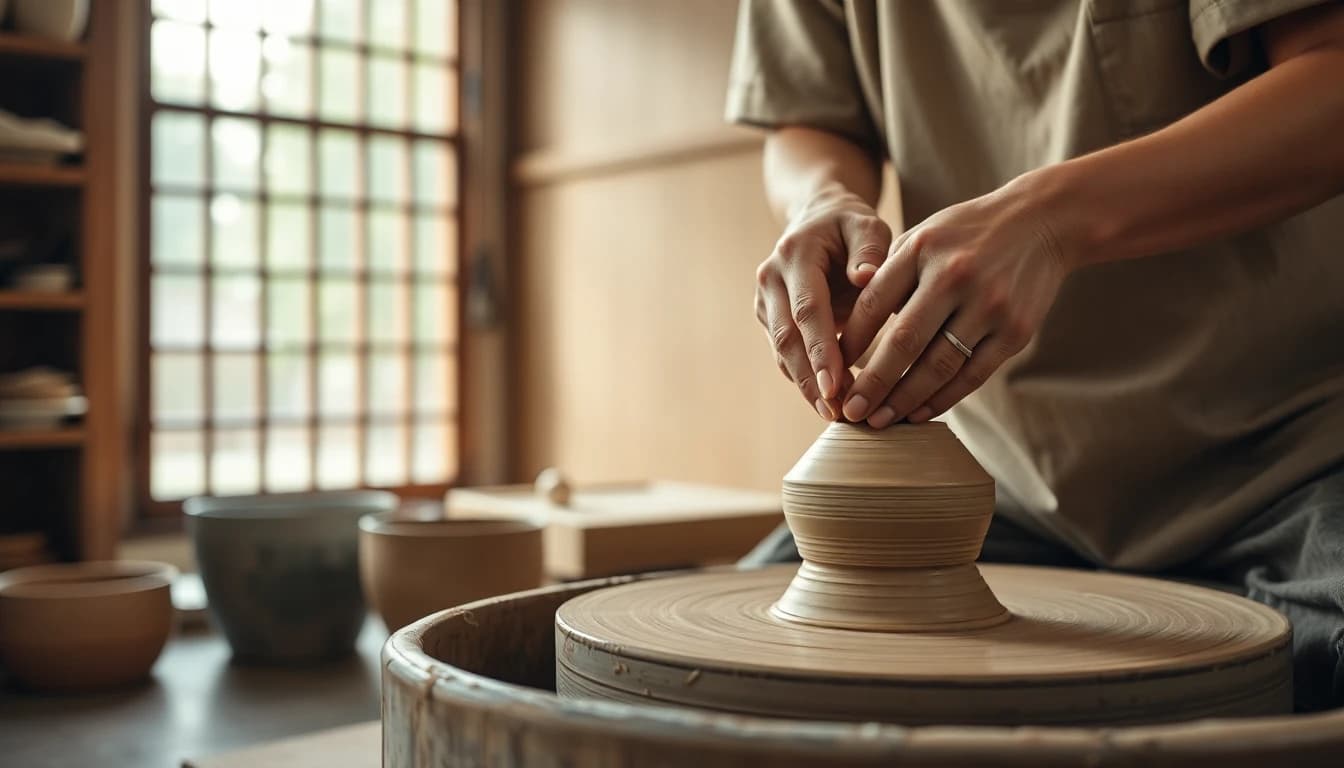
Pottery — Time Spent with Earth and Clay
Recommended Regions
Mashiko (Tochigi Prefecture) — About two hours from Tokyo. The birthplace of Mashiko-yaki pottery, famous for its biannual pottery fairs in spring (April-May) and autumn (November), which draw over 500,000 visitors. More than ten workshops are clustered in the area, with wheel-throwing experiences starting from around 3,500 yen ($23 USD).
Arita (Saga Prefecture) — The birthplace of Japanese porcelain, with a 400-year history and over 200 kilns. The Arita Pottery Fair (late April to early May) attracts a million visitors. Painting experiences start from 2,000 yen ($13 USD).
Tokoname (Aichi Prefecture) — Just 30 minutes by train from Chubu Centrair International Airport. Tokoname's teapots are world-renowned. Walk the Yakimono Promenade and visit workshops along the way — the most accessible pottery town in Japan.
What to Expect
Here is the typical flow of a wheel-throwing pottery experience.
Book and Check In
Online booking is standard. Reserve through Activity Japan, Jalan, or each workshop direct website. Arrive 15 minutes early and put on the provided apron.
Pro Tip: Book 2 months ahead for peak seasons (cherry blossom, Golden Week, autumn leaves). Confirm English availability when booking.
Choose Your Clay and Shape
Watch the artisan demonstrate, then take your turn. Choose between an electric wheel or hand-building (tebineri). On the electric wheel, you shape the clay as it spins. Hand-building lets you freely mold the clay with your hands. Allow 30-60 minutes.
Pro Tip: The electric wheel is where the magic happens — and where things go beautifully wrong. Do not fear mistakes. Follow the artisan guidance and embrace the wobble.
Select Your Glaze
After shaping, choose from 5-10 glaze colors depending on the workshop — white, blue, green, black, and more. Color sample boards help you visualize the final result.
Pro Tip: Glazes change color dramatically during firing. Always check the post-firing sample, not the raw glaze color.
Firing and Delivery
The workshop handles drying, bisque firing, and final firing over 1-2 months. Finished pieces are shipped domestically (500-1,500 yen shipping) or internationally via EMS at select workshops.
Pro Tip: Many workshops do not ship internationally. A reliable workaround: have the piece shipped to your Japanese hotel and carry it home in your luggage.
Itinerary tip: Mashiko is doable as a day trip from Tokyo. A popular plan: pottery workshop in the morning, kiln district walking tour after lunch, and coffee served in a local artisan cup at a Mashiko Main Street cafe in the late afternoon.
Bladesmithing — Enter the World of Fire and Steel
Recommended Regions
Seki (Gifu Prefecture) — Japan's foremost blade-making city, with over 700 years of history dating to the Kamakura period. The Seki Swordsmith Museum offers free demonstrations of traditional sword forging. Hands-on knife-making experiences start at 10,000 yen ($65 USD). The Seki Cutlery Festival (every October) is a pilgrimage for blade enthusiasts.
Sakai (Osaka Prefecture) — Over 90 percent of professional kitchen knives used by Japanese chefs are reportedly made in Sakai. The Sakai Traditional Industry Hall serves as a base for sharpening workshops and forge visits. Just 30 minutes by train from central Osaka.
Echizen (Fukui Prefecture) — Echizen forged blades have a 700-year lineage. At Takefu Knife Village, you can watch blacksmiths at work and forge your own knife (reservation required, from 15,000 yen / $100 USD).
What Can You Make?
| Experience | Price Range | Duration | Difficulty |
|---|---|---|---|
| Paper knife | $33-55 (5,000-8,000 yen) | 1-2 hours | Beginner |
| Small knife | $65-100 (10,000-15,000 yen) | 2-3 hours | Intermediate |
| Japanese kitchen knife (full) | $130-200 (20,000-30,000 yen) | 3-4 hours | Advanced |
| Knife sharpening | $20-33 (3,000-5,000 yen) | 30 min-1 hour | Beginner |
Safety note: Bladesmithing workshops involve high-temperature forges and hot metal. Long sleeves, long pants, and closed-toe shoes are mandatory. Workshops provide goggles and gloves, but your personal safety awareness is essential. Most workshops require minors to be accompanied by a guardian.
A Deep Dive into Sakai Knife Culture
If you are doing a bladesmithing experience in Sakai, consider this itinerary:
- Morning: Learn the history of Japanese knives at Sakai Traditional Industry Hall (free admission)
- Lunch: Try Sakai's famous anago (conger eel) at a heritage restaurant
- Afternoon: Knife sharpening or knife-making workshop
- Late afternoon: Browse Sakai's specialty knife shops and pick out your own blade
Indigo Dyeing — Wearing Japan's Blue
Recommended Regions
Tokushima (Tokushima Prefecture) — "Awa Indigo" is synonymous with Japanese indigo dyeing. During the Edo period, the vast majority of Japan's indigo came from Tokushima. The Ai no Yakata (Indigo Museum) in Aizumi offers dyeing experiences from 1,500 yen ($10 USD). Experiences using authentic sukumo indigo (naturally fermented) start from 3,000 yen ($20 USD).
Musashi-Ranzan, Saitama — About one hour from Tokyo by train. Yumeori no Sato offers mud dyeing and indigo dyeing experiences, with items ranging from handkerchiefs to T-shirts. Reservations accepted until the day before.
Kyoto — Several workshops in central Kyoto offer indigo dyeing. Easy to fit into a sightseeing day, with sessions of about one hour producing finished tenugui hand towels or scarves.
Why Travelers Love Indigo Dyeing
The appeal of indigo dyeing for visitors is straightforward:
- Instant gratification — Unlike pottery, you take your creation home the same day
- No way to fail — Every fold-and-tie pattern creates a unique result, guaranteeing a one-of-a-kind piece
- Light and unbreakable — The most travel-friendly craft souvenir
- Sustainable — Natural indigo has low environmental impact and develops richer character with use
Combination idea: Pair a Tokushima indigo dyeing experience with Iya Valley onsen (hot springs) and a sake brewery tour for the ultimate "dye, soak, and sip" wellness craft trip. Tokushima is the gateway to Shikoku, with easy access to Takamatsu and Matsuyama.
Regional Model Itineraries
If you are unsure how to build your trip, these sample itineraries offer a starting point.
Day Trip from Tokyo (Beginner)
| Time | Activity | Area |
|---|---|---|
| 9:00 | Depart Tokyo Station | — |
| 10:30 | Arrive Mashiko, wheel-throwing experience | Mashiko (Tochigi) |
| 12:30 | Lunch along the kiln district | Mashiko |
| 14:00 | Gallery hopping and shopping | Mashiko |
| 16:00 | Depart Mashiko | — |
| 18:00 | Arrive Tokyo Station | — |
Kansai 3-Day Tour (Intermediate)
- Day 1: Sakai knife culture (Traditional Industry Hall, sharpening workshop, knife shops)
- Day 2: Kyoto indigo dyeing (morning), Kiyomizu-yaki pottery painting (afternoon)
- Day 3: Fushimi sake brewery tour (UNESCO celebration programs available), then on to Osaka
Shikoku + Chugoku 4-Day Tour (Advanced)
- Day 1: Tokushima indigo dyeing, overnight at Iya Valley onsen
- Day 2: Oboke-Koboke gorge hiking, transfer to Takamatsu
- Day 3: Takamatsu to Okayama, Bizen-yaki kiln visit and hand-building experience
- Day 4: Kurashiki Bikan Historical Quarter stroll, depart from Okayama Station
Booking Methods and Practical Information
Major Booking Platforms
| Platform | Features | English Support | URL |
|---|---|---|---|
| Activity Japan | One of the largest craft experience listings in Japan | Yes | activityjapan.com |
| Jalan Experiences | Covers small regional workshops | Partial | jalan.net |
| VELTRA | Designed specifically for international visitors | Yes | veltra.com |
| Workshop direct websites | Most accurate availability | Varies | — |
Price Guide (as of April 2026)
- Pottery (wheel-throwing): 3,000-8,000 yen / $20-55 (shipping extra, 500-1,500 yen)
- Pottery (painting): 1,500-3,000 yen / $10-20
- Bladesmithing: 10,000-30,000 yen / $65-200
- Knife sharpening: 3,000-5,000 yen / $20-33
- Indigo dyeing (handkerchief): 1,500-3,000 yen / $10-20
- Indigo dyeing (T-shirt): 4,000-6,000 yen / $27-40
Booking tip: Popular workshops fill up 2 months in advance. Cherry blossom season (March-April), Golden Week (late April to early May), and autumn foliage (October-November) require early booking. Cancellation policies vary by workshop — always confirm when reserving.
Sake Brewery + Craft: The 2026 Combination Trend
Following the December 2024 UNESCO Intangible Cultural Heritage inscription, tours combining sake brewery visits with craft experiences have emerged as the standout trend for 2026 (Source: Japan Sake and Shochu Makers Association press release).
Recommended Pairings
| Region | Craft Experience | Sake Brewery | Travel Time |
|---|---|---|---|
| Kyoto, Fushimi | Kiyomizu-yaki painting | Gekkeikan, Kizakura | 30 min by train |
| Niigata, Tsubame-Sanjo | Blacksmithing forge visit | Asahi Shuzo, Hakkaisan | 1 hour by car |
| Saga, Arita | Arita-yaki painting | Tenzan Shuzo, Nabeshima | 40 min by car |
| Tokushima | Awa indigo dyeing | Miyoshikiku Shuzo | 30 min by car |
What makes this combination so powerful as a travel experience?
- A feast for all five senses — Shape with your hands (touch), taste sake (taste), watch the kiln fire (sight)
- Deepened regional context — The same local water brews the sake and the same local clay fires the pottery. Recognizing these connections elevates the entire trip
- The perfect souvenir — Drinking local sake from a cup you made yourself. It does not get better than that
Frequently Asked Questions
In Summary — 2026, the Year of Making
Craft tourism in Japan is not a passing trend.
Traditional Japanese craft is evolving from something you observe to something you participate in. Touching an artisan's tools, shaping something with your own hands — what you gain is not just a finished object, but the memory of a place, the texture of a material, and a conversation with a maker that no photograph can fully capture.
In 2026, the new option of sake brewery and craft combination tours has expanded the possibilities further. Pottery festivals in spring and autumn, indigo at its most vibrant in summer, bladesmithing year-round. Whatever season you visit, somewhere in Japan, a craft experience is waiting for you.
Start with just one booking.
Written by Hiro Miyamoto
Founder & CEO of Scratch Second. Starting from corporate sales at a South American food supplier, Hiro went on to spearhead the Japan market launch as VP of Sales at a Silicon Valley foodtech company — placing products in 2,400+ convenience stores and supplying ingredients for an international expo. He currently leads business development across Asia at one of the world's largest tech companies. Off the clock, he's a dedicated yachtsman, yogi, and sauna enthusiast who writes about the intersection of modern healthtech and Japan's timeless wellness traditions.
Related Articles
travel
Wellness Tourism in Japan: 7 Hidden Onsen Towns for the Healing Traveler
Discover 7 secret onsen towns in Japan where ancient toji healing meets modern wellness tourism. Practical guide with budgets, access, and insider tips.
travel
Tea Ceremony Experience in Japan: A First-Timer's Complete Guide to Chado
Everything you need to know about experiencing a Japanese tea ceremony: etiquette, what to expect, best venues in Kyoto, Tokyo, and Kanazawa, and booking tips.
travel
Japan Culture Festivals Abroad 2026: LA, London & Paris Event Guide
Complete guide to Japan culture events in LA, London, and Paris for 2026. Japan House, Hyper Japan, Japan Expo — dates, highlights, and preparation tips for visitors and exhibitors.