travel · 10min read · 2026-02-23
Hidden Onsen in Japan: 7 Secret Hot Springs Worth the Journey
Discover Japan's best-kept onsen secrets. From snow-covered Tohoku pools to UNESCO-listed Yunotsu, here are 7 hidden hot springs and how to visit them.
Key Takeaways
- Seven secret onsen selected for exceptional water quality and genuine atmosphere
- Tsurunoyu in Akita features milky-white sulfur water dating back 300 years
- Hidden onsen are defined by limited English information and inconvenient access
- Japan has over 3,000 onsen towns but most visitors only reach five or six
- Selection criteria include natural water quality and a strong sense of place
Japan has over 3,000 onsen towns. Most visitors flock to the same five or six. Hakone, Beppu, Kusatsu—all wonderful, all crowded. But the country's finest hot springs hide in mountain valleys, along forgotten coastlines, and inside villages where the clock stopped decades ago.
This guide is for travelers who want something different. These seven onsen reward effort. Some require a car. Others demand patience with Japanese-only booking systems. All of them deliver the kind of deep, quiet restoration that mainstream resorts cannot.
What follows combines on-the-ground knowledge with practical logistics so you can plan your own journey.
What Makes a "Hidden" Onsen?
A clarification before we begin. "Hidden" does not mean unknown to Japanese people. Many of these onsen have centuries of history. Local visitors have loved them for generations.
What makes them hidden to international travelers is a combination of factors: limited English information, inconvenient access, Japanese-only reservation systems, and a general absence from English-language guidebooks.
Our selection criteria were simple:
- Not a top-ten fixture in major English travel guides
- Exceptional water quality or unique bathing environment
- A genuine sense of place—not a resort that could exist anywhere
- Accessible (with effort) by public transport or rental car
The 7 Hidden Onsen
1. Tsurunoyu Onsen, Akita — The Milky Waters of Nyuto
Tsurunoyu sits at the end of a narrow road deep in the mountains of Akita Prefecture. It is the oldest of seven inns in the Nyuto Onsenkyo cluster, with records dating back over 300 years.
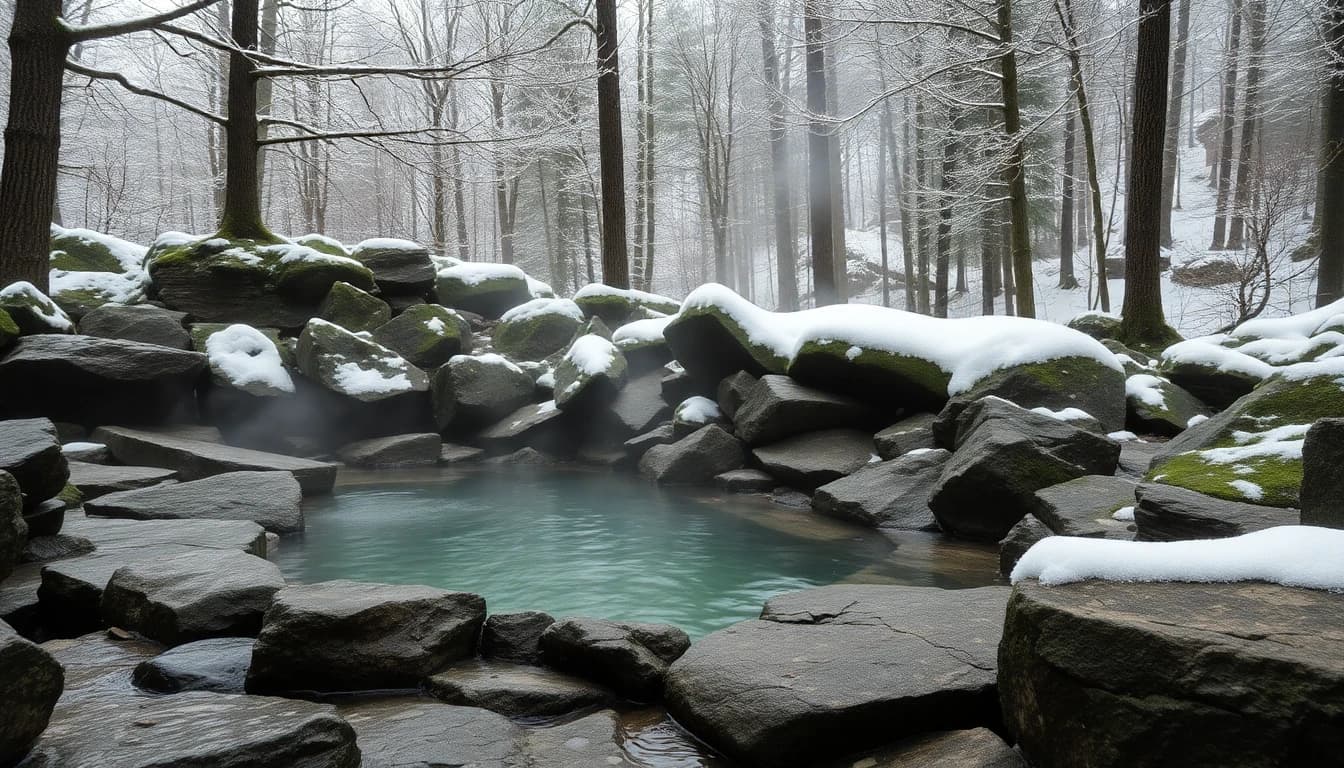
The signature experience is the kon'ya rotenburo (mixed outdoor bath). Milky-white sulfur water fills a large pool surrounded by snow in winter. Steam rises into cedar trees. The silence is almost physical.
The color of the water shifts between pale blue and ivory depending on the light. The sulfur content is high enough that visitors can smell it from the parking lot.
Water type: Sulfur, sodium chloride. Milky white. Temperature around 50°C at the source.
Best season: Winter (December–February). The contrast of hot water and heavy snowfall is unforgettable. Autumn foliage season (October) is also exceptional.
Access: Take the JR Komachi Shinkansen from Tokyo to Tazawako Station (about 3 hours). From there, ride the Ugo Kotsu bus toward Nyuto Onsenkyo. A shuttle runs from the bus stop to Tsurunoyu. Total journey from Tokyo: roughly 4.5 hours.
Cost: Day-use bathing costs 800 yen (approximately $5 USD). Overnight stays with two meals start around 10,000 yen ($65 USD) per person. Cash only—no credit cards accepted.
Booking tip: Reservations open on the 1st of each month, six months in advance. Call at 7:00 AM Japan time. Weekend slots in winter sell out within hours. The reservation line is Japanese only. Consider asking your hotel concierge or a booking service for help.
Honest note: The mixed bath has no partitions. This is traditional konyoku style. If mixed bathing feels uncomfortable, Tsurunoyu also has gender-separated indoor and outdoor baths with the same water quality.
2. Yunotsu Onsen, Shimane — UNESCO World Heritage Hot Spring
Yunotsu is the only onsen town in Japan registered as a UNESCO World Heritage Site. It earned this status as part of the Iwami Ginzan Silver Mine cultural landscape in 2007.
The town itself is remarkably small. One narrow street runs between wooden buildings that have barely changed in a century. Two public bathhouses anchor the experience: Yakushi-yu and Moto-yu.
Yakushi-yu is the star. The water here is sodium chloride-rich, excellent for heat retention. Visitors on a cold evening stay warm for hours afterward. The bathhouse is a simple wooden structure. No frills, no gift shop. Just hot water and history.
Water type: Sodium chloride. Clear, slightly golden. Known for skin-moisturizing properties.
Best season: Year-round, but autumn (October–November) is ideal. The Iwami Kagura dance performance at Tatsunogozenjinja Shrine every Saturday night adds cultural depth to a winter visit.
Access: From Hiroshima, take the highway bus to Hamada (about 2.5 hours), then the JR San'in Line to Yunotsu Station (about 40 minutes). From the station, walk 15 minutes downhill to the onsen street. Alternatively, from Matsue, take the JR San'in Line directly (about 1.5 hours).
Cost: Yakushi-yu charges 500 yen ($3 USD) for adults. Ryokan stays range from 8,000 to 15,000 yen ($52–$98 USD) per person with meals.
Booking tip: The town has only a handful of ryokan. Book directly through Shimane Tourism or Rakuten Travel (Japanese site offers more options). English-language availability is limited.
Bonus: Visit the Yunotsu Pottery Village for a hands-on ceramics experience. The climbing kilns here have fired pottery for over 400 years—a natural pairing for anyone interested in Japanese craft traditions.
3. Shirahone Onsen, Nagano — "Bathe Here, Skip Colds for Three Years"
That old saying—"bathe in Shirahone and you will not catch a cold for three years"—has followed this onsen for centuries. The claim is unprovable, of course. But the water itself is genuinely remarkable.
Shirahone's springs emerge clear from the earth. When the water meets oxygen, dissolved hydrogen sulfide and calcium react. The result is a striking blue-white color that shifts throughout the day. Morning light turns it pale turquoise. By afternoon, it looks like diluted milk.
The village clings to a steep valley in the Northern Alps, near Kamikochi. Eleven ryokan share the hot spring source. The atmosphere is quiet and isolated—exactly what you want from a mountain onsen.
Water type: Hydrogen sulfide, calcium. Blue-white and nearly opaque. Slightly acidic.
Best season: Late autumn (November) for foliage and early winter (December–January) for snow. Summer offers a cool mountain retreat when lowland Japan swelters.
Access: From Matsumoto Station, take the Alpico Kotsu train to Shinshimashima Station, then transfer to a bus bound for Shirahone Onsen. Total travel time: about 2 hours. From Tokyo, the Azusa limited express reaches Matsumoto in 2.5 hours.
Cost: Day-use bathing at Awanoyu (the most photographed bath) costs 1,000 yen ($7 USD). Ryokan stays with kaiseki dinner and breakfast start around 15,000 yen ($98 USD) per person.
Booking tip: Awanoyu's mixed outdoor bath appears in nearly every promotional photo of Shirahone. It fills quickly on weekends. Visit midweek if possible.
Food note: Many ryokan here cook okayu (rice porridge) using the onsen water itself. The mineral content gives it a subtle, almost sweet undertone. Ask for it at breakfast.
4. Misasa Onsen, Tottori — Radium Springs and the Science of Longevity
Misasa Onsen contains some of the highest natural radium levels of any hot spring in the world. Before you recoil: the science here is interesting. Low-dose radiation exposure—a concept called hormesis—has been studied for potential health-promoting effects. Okayama University has conducted research in Misasa on this topic for decades.
None of this is proven therapy. But the 850-year history of people bathing here suggests something worth experiencing.
The town sits along the Mitoku River in rural Tottori Prefecture. The centerpiece is Kawaraburo, a free outdoor mixed bath right on the riverbank. It is open 24 hours. No walls, no roof—just hot water and the sound of the river.
Water type: Radium (radon). Clear, odorless. The water is also suitable for drinking at designated spots.
Best season: Spring (April–May) and autumn (October–November). Summers are warm but manageable. The San'in coast nearby offers day-trip potential year-round.
Access: From Tottori city, take the JR San'in Line to Kurayoshi Station (about 30 minutes), then transfer to the Hinomaru bus bound for Misasa Onsen (about 20 minutes). From Osaka, highway buses run to Kurayoshi in about 3.5 hours.
Cost: Kawaraburo is free. The public bathhouse Kabu-yu charges 500 yen ($3 USD). Ryokan options range from 8,000 to 30,000 yen ($52–$196 USD) per person with meals.
Longevity connection: Research from Okayama University has explored the relationship between radon exposure in Misasa and immune system activity. While results remain preliminary, the town embraces its identity as a "longevity onsen." For more on the science of hot springs and health, see our longevity section.
🛑 Safety Notice
Honest note: Kawaraburo is fully open-air with no privacy barriers. It sits beside a pedestrian bridge. Comfort levels will vary. Gender-separated indoor baths are available at ryokan and public bathhouses throughout the town.
5. Kurokawa Onsen, Kumamoto — The Onsen-Hopping Village
Kurokawa Onsen invented a system that other onsen towns now imitate. The nyuto tegata is a wooden medallion that costs 1,300 yen ($9 USD). It grants entry to three different bathhouses of your choice across the village.
This simple idea transforms a single onsen visit into an afternoon of exploration. Walk between ryokan along a forested river gorge. Try a cave bath carved by hand with a hammer and chisel. Soak in a rotenburo overlooking a waterfall. Each bathhouse has its own character.
The village sits in the Aso volcanic region of Kumamoto Prefecture. Twenty-eight ryokan cluster along a narrow valley. Wooden bridges, lantern-lit paths, and the sound of running water define the atmosphere.
Water type: Varies by source—sulfur, sodium chloride, and iron springs coexist within the village. Colors range from clear to milky to rust-tinged.
Best season: Winter (December–February) for snow-covered rotenburo. Late autumn (November) for foliage along the gorge. Avoid Golden Week (late April–early May) and Obon (mid-August) when domestic tourism peaks.
Access: From Kumamoto Station, direct buses run three times daily (9:15 AM, 11:15 AM, 12:40 PM). The ride takes about 3 hours. From Fukuoka, highway buses reach Kurokawa in about 3 hours via the Aso area. A rental car from Kumamoto Airport cuts the trip to 1.5 hours and is the most flexible option.
Cost: Nyuto tegata: 1,300 yen ($9 USD) for three bathhouses. Individual day-use entry: 500–800 yen ($3–5 USD). Ryokan stays: 15,000–40,000 yen ($98–$261 USD) per person with meals.
Booking tip: Kurokawa is more well-known than the other entries on this list. It appears in some Japanese guidebooks. Visit on weekdays outside peak seasons for the quietest experience. Book ryokan through Japan Guide for English-friendly options or Jalan (Japanese) for the full range.
6. Nozawa Onsen, Nagano — Ski Village with 13 Free Public Baths
Nozawa Onsen achieves something rare: it is both a serious ski destination and a living onsen village. Thirteen sotoyu (public bathhouses) dot the streets. All of them are free. All of them are maintained by local residents who use them daily.
The sotoyu are housed in Edo-period wooden structures. Inside, the experience is raw. No amenities. No shampoo. Just a changing area and a bath filled with water hot enough to make you gasp. Temperatures routinely hit 45–49°C. Locals ease in without flinching. Visitors learn to go slowly.
Oyu, the largest bathhouse, sits at the village center. Its wooden facade is a landmark. But the smaller sotoyu—Kawarayu beside the river, Kumanotearaiyu with its silky alkaline water—offer more intimate experiences.
Water type: Varies by bathhouse. Sulfur, sodium, and alkaline springs. Temperatures are notably high.
Best season: Winter (December–March) for the ski-and-soak combination. The Dosojin Fire Festival in mid-January is one of Japan's most dramatic cultural events—a towering wooden structure set ablaze while villagers battle to protect and attack it.
Access: From Tokyo, take the Hokuriku Shinkansen to Iiyama Station (about 90 minutes). Transfer to the Nozawa Onsen Liner bus (25 minutes). Total door-to-door time from central Tokyo: under 2.5 hours. This is the most accessible onsen on our list.
Cost: All 13 sotoyu are free. A small donation (100–200 yen) in the collection box is customary and appreciated. Ryokan and guesthouse stays range from 6,000 to 25,000 yen ($39–$163 USD) per person.
Culture tip: The sotoyu belong to the community, not to tourists. Keep visits brief during morning hours (5:00–8:00 AM) when locals bathe before work. Evening hours (after 7:00 PM) tend to be quieter for visitors.
Ski connection: Nozawa Onsen Snow Resort offers 36 courses across 297 hectares. A day pass costs around 5,800 yen ($38 USD). The combination of morning skiing and afternoon onsen hopping is one of the best winter experiences in Japan.
7. Rausu Onsen, Hokkaido — Where Bears and Hot Springs Coexist
The Shiretoko Peninsula holds Japan's highest density of brown bears. It is also a UNESCO World Heritage Site, recognized for its extraordinary biodiversity. Rausu sits on the eastern coast, facing the Nemuro Strait and, on clear days, the disputed Kuril Islands.
The onsen experience here is wild in the literal sense. Kumanoyu ("Bear Bath") is a free outdoor bath on the banks of the Rausu River, surrounded by virgin forest. Two pools—one for men, one for women—are maintained by the Rausu Onsen Appreciation Society. There are no buildings. Changing happens behind a simple screen.
For the truly adventurous, Seseki Hot Spring appears only at low tide. Seawater covers it at high tide. You soak in a rocky pool on the shore of the Nemuro Strait with the open ocean in front of you. It operates only from July through September.
Water type: Sodium chloride (Kumanoyu), mixed seawater-spring water (Seseki). Temperatures vary with tide and season.
Best season: Summer (July–September) for Seseki and the best weather. Late September–October for autumn foliage and salmon runs that attract bears to the rivers.
Access: Fly to Memanbetsu Airport (from Tokyo Haneda, about 1.75 hours). Rent a car—there is no practical public transport to Rausu. Drive through Shari and over the Shiretoko Pass (about 2.5 hours total from the airport). The pass closes in winter (November–April).
Cost: Kumanoyu is free. Seseki is free. Accommodation in Rausu ranges from minshuku (guesthouses) at 5,000 yen ($33 USD) to ryokan at 15,000 yen ($98 USD) per person with meals.
🛑 Safety Notice
Safety note: Bear encounters are a real possibility. Do not hike alone. Carry bear bells and bear spray. Follow local guidance from the Shiretoko Nature Center. This is not a controlled tourist environment—that is precisely what makes it remarkable.
Wildlife bonus: Rausu is one of the best places in Japan for whale watching (sperm whales and orcas frequent the strait) and winter eagle cruises (Steller's sea eagles gather from January to March).
Onsen Etiquette: A Quick Guide for First-Timers
Japanese onsen follow unwritten rules that locals learn from childhood. Foreign visitors are not expected to know everything. But showing respect for these customs goes a long way.
Tattoo policies This is improving but still inconsistent. Many rural onsen—including several on this list—are relaxed about tattoos, especially for visibly foreign visitors. Larger hotel-style onsen tend to be stricter. Options if you have tattoos:
- Ask before entering. A polite inquiry at the front desk avoids awkwardness.
- Use waterproof tattoo covers (available at pharmacies and online). Some onsen provide them.
- Book a private bath (kashikiri). These are available at many ryokan and eliminate the issue entirely.
- Prioritize free outdoor baths (Kawaraburo in Misasa, Kumanoyu in Rausu) where enforcement is rare.
Practical Tips
Best Season for Each Onsen
Tsurunoyu (Akita) — Peak: Winter (Dec-Feb). Also good: Autumn (Oct). Avoid: Late March (muddy) Yunotsu (Shimane) — Peak: Autumn (Oct-Nov). Also good: Year-round Shirahone (Nagano) — Peak: Late autumn-winter. Also good: Summer (cool retreat). Avoid: Heavy snow closures (Jan-Feb roads) Misasa (Tottori) — Peak: Spring (Apr-May). Also good: Autumn (Oct-Nov) Kurokawa (Kumamoto) — Peak: Winter (Dec-Feb). Also good: Autumn (Nov). Avoid: Golden Week, Obon Nozawa (Nagano) — Peak: Winter (Dec-Mar). Also good: Fire Festival (mid-Jan). Avoid: Rainy season (Jun) Rausu (Hokkaido) — Peak: Summer (Jul-Sep). Also good: Autumn (Oct). Avoid: Winter (pass closed)
Getting There: Car vs. Train vs. Bus
Rental car recommended: Rausu (essential), Kurokawa (highly useful), Shirahone (convenient), Misasa (convenient).
Train + bus works: Tsurunoyu, Yunotsu, Nozawa Onsen.
Best public transport access: Nozawa Onsen (Shinkansen + 25-minute bus). This is the easiest onsen on the list to reach without a car.
If renting a car, book through Nippon Rent-A-Car or Times Car Rental. Both have English-language websites and offices at major stations and airports. An international driving permit is required for most foreign licenses.
Booking Tips
Japanese onsen ryokan often use domestic-only booking platforms. Here are your options:
- Rakuten Travel (travel.rakuten.com) — largest selection, some English pages. Japanese site has more inventory.
- Jalan (jalan.net) — Japanese only, but Google Translate handles it reasonably well. Best for small, family-run ryokan.
- Booking.com / Agoda — limited selection for remote onsen, but useful as a backup.
- Phone reservations — some traditional ryokan accept only phone bookings. If you do not speak Japanese, ask your current hotel to call on your behalf. This is common practice and staff are accustomed to it.
Budget Guide
- Free public baths ($0) — Nozawa sotoyu, Misasa Kawaraburo, Rausu Kumanoyu
- Day-use bathing ($3-$7) — Most public bathhouses
- Budget ryokan ($39-$65/night, meals included) — Simple rooms, shared facilities
- Mid-range ryokan ($98-$163/night, meals included) — Private room, kaiseki dinner, private or semi-private bath
- Premium ryokan ($196-$300+/night, meals included) — In-room onsen, multi-course kaiseki, historic properties USD conversions based on 1 USD = approximately 153 yen (as of early 2026).
Start Planning Your Onsen Journey
These seven onsen represent a fraction of what Japan offers beyond the guidebooks. Each one rewards the traveler who makes the effort to reach it. The water is hotter, the crowds are thinner, and the connection to place runs deeper.
Start with one. Nozawa Onsen is the easiest first step—under 2.5 hours from Tokyo with free baths waiting. From there, let curiosity guide you deeper into the map.
For more on Japanese wellness traditions, artisan culture from onsen regions, and other journeys off the beaten path, explore the rest of Scratch Second.
Want dispatches from hidden Japan twice a month? Join our newsletter for onsen guides, artisan spotlights, and wellness travel insights that never touch a guidebook.
Written by Hiro Miyamoto
Founder & CEO of Scratch Second. Starting from corporate sales at a South American food supplier, Hiro went on to spearhead the Japan market launch as VP of Sales at a Silicon Valley foodtech company — placing products in 2,400+ convenience stores and supplying ingredients for an international expo. He currently leads business development across Asia at one of the world's largest tech companies. Off the clock, he's a dedicated yachtsman, yogi, and sauna enthusiast who writes about the intersection of modern healthtech and Japan's timeless wellness traditions.
Related Articles
travel
Wellness Tourism in Japan: 7 Hidden Onsen Towns for the Healing Traveler
Discover 7 secret onsen towns in Japan where ancient toji healing meets modern wellness tourism. Practical guide with budgets, access, and insider tips.
travel
Tea Ceremony Experience in Japan: A First-Timer's Complete Guide to Chado
Everything you need to know about experiencing a Japanese tea ceremony: etiquette, what to expect, best venues in Kyoto, Tokyo, and Kanazawa, and booking tips.
travel
Craft Tourism in Japan 2026: A Guide to Pottery, Bladesmithing & Indigo Dyeing
The complete guide to hands-on craft experiences in Japan for 2026. Pottery, bladesmithing, and indigo dyeing — with booking tips, prices, access, and recommended regions.