
craft · 12min read · 2026-04-01
Japanese Textiles and Indigo Dyeing: A Complete Guide to Japan's Fabric Heritage
Explore Japan's textile traditions from aizome indigo dyeing to Nishijin-ori silk weaving. Covers shibori, kasuri, bingata, regional specialties, and a collecting guide.
Key Takeaways
- Aizome natural indigo uses fermented sukumo, used by less than 1% of indigo dyers
- Nishijin-ori silk weaving requires 23 separate processes before the first shuttle pass
- Shibori, kasuri, and bingata are three distinct Japanese dyeing techniques
- Tokushima Prefecture has been Japan's indigo production center for over 300 years
- Japan's Living National Treasure system protects master textile artisans
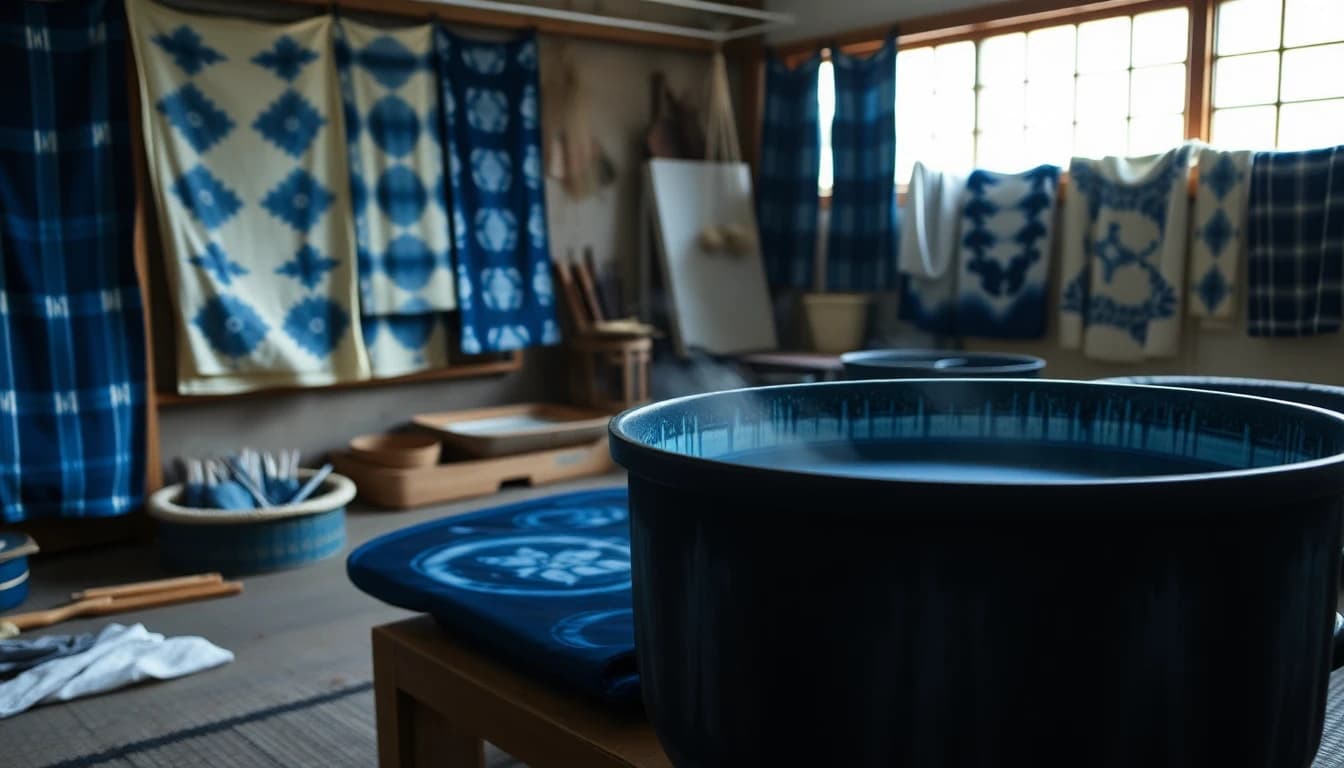
Dip a length of white cotton into a vat of fermented indigo leaves, pull it out, and watch the fabric transform. For a few seconds it is green -- the color of the living dye. Then oxygen hits the surface and the green deepens, shifts, and locks into blue. Not any blue. Japan Blue -- the color that so astonished Western visitors during the Meiji era that they coined the phrase to describe a shade they had never seen elsewhere.
This single chemical reaction -- indigo oxidizing on cotton fiber -- has shaped Japanese material culture for over a thousand years. It colored the work clothes of farmers, the battle garments of samurai, the festival banners of fishermen, and the fine robes of court nobles. And it is only one thread in a textile tradition that encompasses some of the most sophisticated dyeing and weaving techniques ever developed.
Japan's textile heritage is not a museum artifact. Artisans in Tokushima still grow their own indigo plants. Weavers in Kyoto's Nishijin district still operate looms that require twenty-three separate processes before a shuttle makes its first pass. Okinawan bingata makers still hand-apply resist paste through centuries-old stencils. This work continues because these textiles are irreplaceable -- no machine can replicate the depth of a naturally fermented indigo, the tension of a hand-drawn kasuri pattern, or the luminous color density of a Nishijin gold brocade.
This guide maps the major traditions, explains the techniques that distinguish them, identifies where they are made and where to find them, and offers practical advice for anyone who wants to begin collecting Japanese textiles.
A Timeline of Japanese Textile History
The Five Major Textile Traditions
1. Aizome: Indigo Dyeing
Aizome (藍染) is Japan's most iconic dyeing tradition and arguably its most important single contribution to global textile culture. The process begins not in a studio but in a field, with the cultivation of Persicaria tinctoria -- the Japanese indigo plant.
The journey from plant to dye is extraordinarily labor-intensive. Harvested leaves are composted over several months with water and ash, turned repeatedly by hand, until they ferment into a concentrated dyestuff called sukumo. The sukumo is then dissolved in a lye solution and maintained as a living fermentation vat -- a biological system containing bacteria that must be fed, monitored, and adjusted daily. A healthy vat has a greenish surface, a sweet-sour smell, and a personality that experienced dyers describe in almost human terms.
Where it is made: Tokushima Prefecture is the heartland. The town of Aizumi and the city of Mima have over 300 years of history as indigo production centers. Only a handful of aishi (indigo artisans) remain who cultivate plants, produce sukumo, and dye textiles -- the complete traditional process (Source: JNTO, Exploring the Origins of Aizome).
What to look for when buying:
- Natural vs. synthetic: Ask whether the dye is natural sukumo (tennen-ai) or synthetic (gosei-ai). Price is a reliable indicator -- naturally dyed goods cost three to ten times more
- Depth of color: Natural indigo produces a softer, more complex blue that deepens with repeated dipping. Synthetic indigo tends toward a flatter, more uniform tone
- Hand feel: Naturally dyed fabric often feels slightly stiffer initially but softens beautifully with wear and washing
- Aging: Natural aizome fades gradually into lighter blues over years of use, each shade more beautiful than the last. This wabi-sabi aging is considered a feature, not a flaw
Price range: A naturally dyed cotton tenugui (hand towel) starts at $15-$30. Scarves and stoles range from $50-$200. Garments can reach $500-$3,000 depending on the artisan and complexity.
2. Nishijin-ori: Kyoto Silk Weaving
Nishijin-ori (西陣織) is the aristocrat of Japanese textiles. Produced in the Nishijin district of Kyoto for over five centuries, these silk fabrics are woven with pre-dyed threads -- including gold and silver metallic threads -- to create patterns of extraordinary density, complexity, and luminosity.
The production process is staggering in its intricacy. A single bolt of Nishijin obi fabric may require twenty-three separate production steps and the coordinated work of multiple specialist artisans: thread dyers, pattern designers, loom preparers, weavers, and finishers. A complex obi can take a weaver several months to complete on a traditional hand-operated loom.
Where it is made: The Nishijin district in northwestern Kyoto. The Nishijin Textile Center serves as a museum, demonstration space, and retail center for over 700 small companies in the area (Source: Kogei Japonica, Nishijin Weaving).
The challenge: Nishijin-ori faces serious structural decline. Production volumes have fallen to roughly 20% of their 1990 peak. The number of active weavers, looms, and workshops continues to shrink as artisans age and young people choose other careers (Source: International Journal of Intangible Heritage, Vol. 429). Every Nishijin textile purchased today is both an art acquisition and an act of cultural preservation.
What to look for when buying:
- Obi (sash): The primary product. Formal obi for kimono range from $300 to $30,000+ for masterwork pieces
- Interior textiles: Table runners, cushion covers, wall hangings, and accessories using Nishijin techniques at more accessible prices ($50-$500)
- Nishijin Textile Center label: Authentic products carry an association label verifying origin
- Thread density: Higher quality Nishijin has denser weaving with finer threads. Hold the fabric up to light -- less light passes through higher-quality weaves
3. Kasuri: Resist-Dyed Patterning
Kasuri (絣), known internationally as ikat, is a technique where threads are bound and dyed before weaving, creating patterns that emerge as the fabric is woven. The slight irregularities where dyed and undyed sections meet -- the characteristic "blur" at pattern edges -- is kasuri's defining visual signature and its greatest charm.
Japan developed kasuri to a level of precision unmatched elsewhere. In e-gasuri (picture kasuri), individual threads are calculated and bound so precisely that the woven fabric reveals detailed images -- landscapes, flowers, kanji characters -- composed entirely of dyed warp and weft threads. This requires the dyer to visualize the finished pattern and reverse-engineer it thread by thread.
Regional varieties:
- Kurume-gasuri (Fukuoka): The most famous. Designated an Important Intangible Cultural Property. Known for deep indigo patterns on cotton. Price: $100-$1,000 per bolt
- Iyo-gasuri (Ehime): Lighter, more delicate patterns. Often features white-on-blue designs
- Bingo-gasuri (Hiroshima): Historically the largest production center. Patterns tend toward geometric simplicity
- Miyako-jofu (Okinawa): Ultra-fine ramie kasuri. Each bolt takes months to produce. Museum-quality textile art. Price: $3,000-$10,000+ per bolt
4. Shibori: Shaped-Resist Dyeing
Shibori (絞り) is Japan's tie-dye tradition -- though that comparison undersells the technique by several orders of magnitude. While Western tie-dye typically involves rubber bands and random patterns, Japanese shibori encompasses dozens of distinct binding, folding, stitching, and clamping techniques, each producing different patterns with mathematical precision.
The word derives from the verb shiboru (to wring or squeeze), describing the physical action of compressing fabric before dyeing. Where the fabric is compressed, dye cannot penetrate. The artisan controls the pattern by controlling the compression.
Major shibori techniques:
- Kanoko shibori: Tiny, individually bound dots. The technique behind the distinctive "fawn spot" pattern seen in Kyoto's most expensive kimono. A single kimono may require 200,000 individually tied points
- Arashi shibori: Fabric wrapped diagonally around a pole and compressed. Produces dramatic diagonal stripe patterns resembling rain (arashi means storm)
- Itajime shibori: Fabric folded and clamped between wooden blocks. Produces bold geometric patterns
- Kumo shibori: Fabric pleated and bound in sections. Creates spider-web-like radial patterns
- Miura shibori: Fabric hooked and bound with thread without knotting. Produces a distinctive looped texture
Where it is made: Arimatsu and Narumi in Nagoya are the historic centers. Arimatsu shibori has been produced along the old Tokaido highway since 1608. Kyoto produces the most refined kanoko shibori for formal kimono.
Price range: Shibori tenugui from $15-$40. Scarves from $50-$300. Kimono fabric from $500 to $50,000+ for full kanoko shibori.
5. Bingata: Okinawan Stencil Dyeing
Bingata (紅型) stands apart from mainland Japanese textile traditions in almost every way. Where aizome celebrates a single color, bingata riots with dozens. Where shibori works through subtraction (blocking dye), bingata works through application (pushing pigment through stencils). The technique is Okinawan, not Japanese in origin -- a product of the Ryukyu Kingdom that maintained cultural independence from Japan until 1879.
Bingata makers carve intricate stencils from persimmon-tanned paper, lay them on fabric, and apply resist paste through the openings. Color is then painted on by hand -- red, yellow, blue, green, purple -- in combinations that reflect the subtropical palette of Okinawa rather than the muted tones of mainland Japan.
Where it is made: Primarily in Naha, Okinawa. A small number of workshops maintain the tradition, with the most significant being in the Shuri district.
What distinguishes authentic bingata:
- Hand-carved stencils (not photochemical)
- Hand-applied natural and mineral pigments
- Motifs drawn from Okinawan nature: hibiscus, phoenix, ocean waves, tropical fish
- Fabric has visible texture from the resist paste application
Price range: Small items (coasters, pouches) from $20-$60. Scarves and wall hangings from $100-$800. Kimono-length fabric from $2,000-$15,000+.
Regional Textile Map
Japan's geography directly shapes its textile traditions. Climate, available fibers, water quality, and historical trade routes all determine what is made where.
Northern Japan (Tohoku)
- Tsumugi silk: Rustic, hand-spun silk with a distinctive nubby texture. Yonezawa-tsumugi (Yamagata) and Ojiya-chijimi (Niigata) are notable varieties
- Kogin-zashi: Geometric counted-thread embroidery from Aomori. Originally a practical technique to reinforce and insulate hemp clothing
- Climate influence: Long winters create time for labor-intensive textile work. Cold temperatures suit hemp and ramie processing
Central Japan (Kanto / Chubu)
- Kiryu textiles (Gunma): Silk weaving center rivaling Nishijin, with over 1,300 years of history
- Echigo-jofu (Niigata): Ultra-fine ramie fabric, UNESCO Intangible Cultural Heritage. Snow-bleaching technique unique to the region
- Arimatsu shibori (Aichi): The historic shibori production center along the old Tokaido road
Western Japan (Kansai / Chugoku)
- Nishijin-ori (Kyoto): The pinnacle of Japanese silk weaving
- Kurume-gasuri (Fukuoka): The most celebrated kasuri tradition
- Bizen textiles (Okayama): Lesser known than Bizen pottery but equally rooted in the region's craft culture
Southern Japan (Shikoku / Kyushu / Okinawa)
- Awa indigo (Tokushima): Japan's indigo production heartland
- Bingata (Okinawa): The Ryukyuan stencil-dyeing tradition
- Oshima-tsumugi (Kagoshima): Mud-dyed silk with a distinctive brown-black color, dyed using iron-rich mud from local fields. One of Japan's most expensive silk textiles
The Production Process: How Natural Indigo Is Made
Understanding the production of natural indigo -- from field to fabric -- reveals why genuine aizome commands the prices it does.
Growing (March-July)
Indigo seeds are planted in March. The plants require rich, well-drained soil and consistent moisture. The Yoshino River valley in Tokushima provides ideal conditions. Plants are harvested twice: once in July and once in September.
Processing into Sukumo (August-January)
Harvested leaves are dried, moistened, and composted in a process called aishi-no-shigoto (the work of the indigo maker). The composting pile is turned every few days for approximately 100 days, during which microbial fermentation converts the leaf pigment into concentrated dyestuff. The resulting sukumo resembles dark, crumbly soil.
Building the Vat (Ongoing)
Sukumo is dissolved in lye (traditionally wood ash lye) and maintained as a living fermentation system. The vat requires daily attention -- feeding with bran or sake, adjusting pH, monitoring temperature. A master dyer can read the vat's health by its color, smell, and the way bubbles form on the surface.
Dyeing (Ongoing)
Fabric is dipped repeatedly into the vat. Each dip adds a layer of color. Light blues require three to five dips. The deepest indigo, called nou-kon (dark navy), may require twenty or more dips over several days, with drying and oxidation between each immersion.
Finishing
Dyed fabric is washed in running water to remove excess dye, then dried in sunlight. The finished fabric is slightly stiff with a clean, organic smell. Over time and use, the indigo softens, fades gradually, and develops the character that makes old aizome textiles so prized by collectors.
Modern Revival and Global Influence
Japanese textile traditions are experiencing a genuine renaissance, driven by three converging forces.
Sustainability Movement
The global fashion industry is responsible for approximately 10% of annual global carbon emissions (Source: UNEP, 2024). Natural dyeing techniques like aizome produce zero synthetic chemical waste and use biodegradable materials. Brands including Kapital, Blue Blue Japan, and Studio D'Artisan have built international followings by combining traditional indigo dyeing with contemporary denim and workwear design.
Japanese Denim
Japan's selvedge denim industry -- now considered the world's finest -- grew directly from the country's indigo dyeing heritage. Brands in Okayama and Hiroshima prefectures produce denim that is rope-dyed with indigo (both natural and synthetic) on vintage shuttle looms. The attention to raw materials, dyeing process, and weaving quality mirrors the craft approach of traditional Japanese textiles.
Artisan Tourism
Visitors increasingly seek hands-on experiences with textile artisans. Workshops in Tokushima, Arimatsu, Kyoto, and Okinawa offer everything from one-hour introductory classes to multi-day immersive residencies. This tourism provides crucial income for artisans while spreading awareness of techniques that might otherwise fade.
A Collecting and Buying Guide
For Beginners (Under $100)
- Aizome tenugui (hand towels): $15-$30. The most accessible entry point. Use them daily and watch the indigo evolve
- Shibori scarves: $30-$80. Arimatsu shibori makes excellent lightweight scarves
- Bingata coasters or pouches: $20-$60. Small but vivid examples of the Okinawan tradition
- Furoshiki: $10-$40 for cotton. Functional art you will use every week
For Intermediate Collectors ($100-$1,000)
- Kasuri fabric lengths: $100-$500. Frame them, use them as table runners, or have them tailored into garments
- Nishijin-ori accessories: $50-$300. Coin purses, card cases, and small bags showcase the weaving at accessible prices
- Aizome garments: $200-$800. Naturally dyed shirts, scarves, and accessories from Tokushima artisans
- Vintage shibori: $100-$600. Antique shibori fabrics at Japanese flea markets and textile dealers
For Serious Collectors ($1,000+)
- Nishijin obi: $1,000-$30,000+. The ultimate Japanese textile art form. Even non-kimono wearers display these as wall art
- Miyako-jofu kasuri: $3,000-$10,000+. Museum-quality ramie kasuri from Okinawa
- Full kanoko shibori kimono: $5,000-$50,000+. Wearable art requiring months of individual dot-tying
- Antique textiles: Japanese auction houses and specialty dealers offer Edo and Meiji-era textiles. Provenance documentation is essential
Where to Buy
In Japan:
- Tokushima: Rampuya (est. 1912) for aizome, Aiyakazou for multiple artisans' work
- Kyoto: Nishijin Textile Center for silk, various aizome shops along Teramachi-dori
- Arimatsu (Nagoya): The shibori district has shops and workshops along the historic street
- Okinawa: Shuri district in Naha for bingata. Tsuboya area for combined ceramics and textiles
- Flea markets: Toji Temple (Kyoto, 21st monthly), Oedo Antique Market (Tokyo, first/third Sunday). Vintage textiles at fraction of retail
Online:
- BECOS (en.thebecos.com): Curated Japanese crafts including textiles, with English descriptions and international shipping
- Zentner Collection: Gallery specializing in Japanese natural-dye textiles
- Thread Caravan: Textile travel experiences with an online shop component
Authentication Tips
- Natural indigo smell: Genuine aizome has a faint, earthy, organic scent even after washing. Synthetic indigo has no scent
- Rub test: Rub a corner of naturally dyed fabric on white cloth. Natural indigo transfers a faint blue. Synthetic typically does not
- Price reality: A hand-dyed, naturally produced indigo scarf should cost $50 minimum. If it costs $15, it is almost certainly synthetic
- Artisan documentation: Reputable sellers provide information about the specific artisan or workshop
Visiting an Indigo Workshop: My Tokushima Experience
I visited an indigo workshop in Tokushima Prefecture on a November morning when the sukumo composting season was ending and the dyeing vats were at their deepest blue. The workshop sat alongside rice paddies, in a wooden building that smelled like wet earth and something faintly sweet -- the living fermentation vat announcing itself from twenty meters away.
The master dyer lifted the wooden lid from a vat that had been active for three months. The surface was dark green with a metallic sheen -- "the flower," he called it, the layer of indigo bubbles that indicates a healthy vat. He scooped a ladle of the liquid, held it to the light, and nodded.
I dipped a cotton cloth into the vat. It came out green. Not blue. Green. "Wait," he said. So I waited, holding the dripping cloth in the November air. Over sixty seconds, the green shifted. Deepened. The edges turned blue first, then the center. Chemistry I had read about was happening in my hands, and it felt less like a craft demonstration than a magic trick.
After five dips -- green, wait, blue, dip again -- the cloth was a vivid medium indigo. The dyer showed me a sample he had dipped twenty-two times. It was so dark it was nearly black, with a depth that synthetic dye simply cannot produce. Each layer of natural indigo adds dimension, not just density. The color has a quality I can only describe as alive.
Japanese Textiles and the Broader Craft World
Textiles connect to every other corner of Japanese craft culture. The same aesthetic principles -- reverence for natural materials, acceptance of imperfection, the belief that handwork carries something a machine cannot replicate -- run through Japanese pottery, lacquerware, kitchen knives, and furoshiki wrapping.
Many of these traditions cluster geographically. Japan's hidden artisan towns -- Arimatsu, Aizumi, the Nishijin district -- are living workshops where you can witness production, meet makers, and purchase directly. The experience of buying a textile from the hands that dyed it is fundamentally different from clicking "add to cart."
Frequently Asked Questions
Written by Hiro Miyamoto
Founder & CEO of Scratch Second. Starting from corporate sales at a South American food supplier, Hiro went on to spearhead the Japan market launch as VP of Sales at a Silicon Valley foodtech company — placing products in 2,400+ convenience stores and supplying ingredients for an international expo. He currently leads business development across Asia at one of the world's largest tech companies. Off the clock, he's a dedicated yachtsman, yogi, and sauna enthusiast who writes about the intersection of modern healthtech and Japan's timeless wellness traditions.
Related Articles
craft
Wajima Lacquerware: Why Japan's Most Resilient Craft Deserves Your Attention
A complete guide to Wajima-nuri lacquerware — the 124-step process, how it compares to other Japanese lacquer, what to buy, where to buy, and how Wajima is r...
craft
Japan's Matcha Exports Surpass 10,000 Tons for the First Time in 71 Years
In 2025, Japanese tea exports exceeded 10,000 tons for the first time since 1954. Behind the matcha boom lies a deepening supply shortage, soaring prices, and a structural shift in Japan's tea farming industry.
craft
Why HOSOO Moves the World — A 327-Year-Old Nishijin Weaver's Path to Dior and Chanel
How HOSOO, a 327-year-old Nishijin-ori weaving house in Kyoto, became the textile supplier to Dior, Chanel, and Hermes. An in-depth look at their 150cm-wide loom innovation, LVMH partnership, and Milan expansion.